
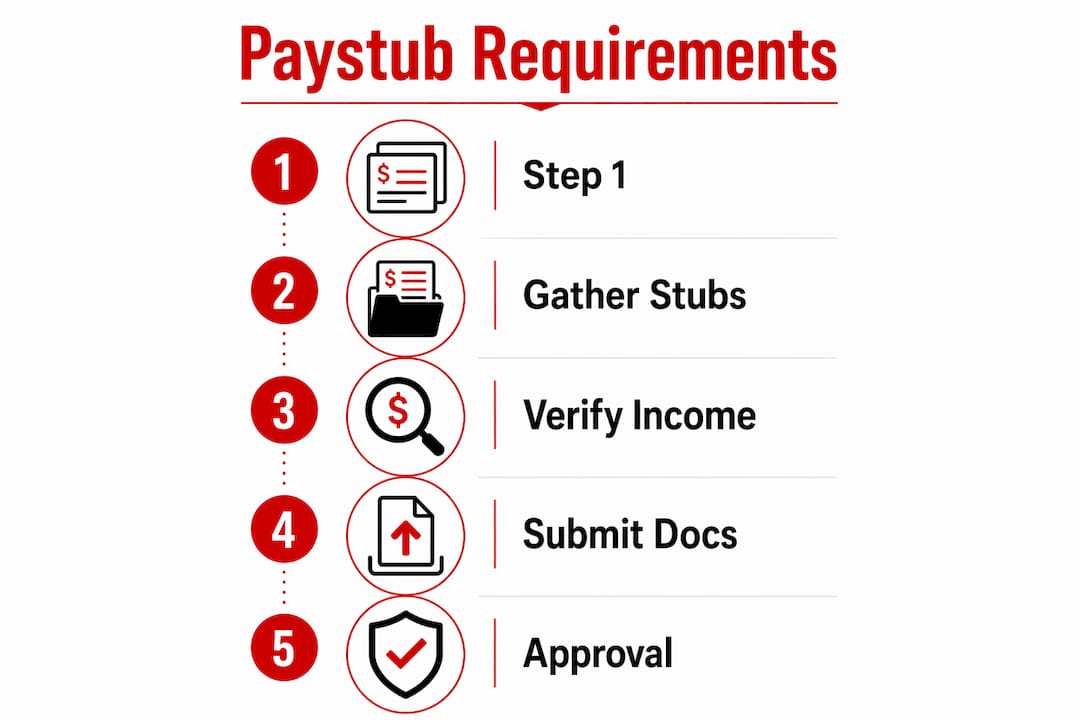
The paystub requirement in car financing is the lender's demand for recent, documented proof of income to verify your ability to repay an auto loan. Most lenders require 1–2 consecutive, recent pay stubs covering the last 30 days before approving a formal application. Understanding what is paystub requirement car financing means knowing that this standard applies whether you have excellent credit or are rebuilding it. Your FICO score, employment type, and pay frequency all shape exactly how many stubs you need and what else lenders may ask for. Getting this right before you apply saves time and prevents unnecessary delays.
What is the paystub requirement for car financing?
A paystub requirement is the lender's formal request for physical income documentation during the auto loan application process. Lenders rely on self-reported income during prequalification, but they require documented proof once you submit a formal application involving a hard credit pull. That shift from self-reported to verified income is where most borrowers get caught off guard.
The standard expectation across the lending industry is 1–2 recent, consecutive pay stubs. Subprime borrowers with FICO scores below 670 almost always must provide 2 consecutive stubs covering the past 30 days. Borrowers with stronger credit profiles may face lighter documentation requirements, but that is not guaranteed.

Even a large down payment does not exempt you from this requirement. Lenders still verify income to confirm you can make ongoing monthly payments, regardless of how much cash you put down upfront. The down payment reduces risk on the loan balance. It does not replace proof of consistent earnings.
How do lenders use paystubs to verify income?
Lenders do not simply glance at your gross pay figure. They examine specific data points on each stub to build a picture of your financial reliability. The four elements they check most closely are gross income, year-to-date earnings, employer information, and deductions.
Year-to-date earnings reveal whether your income is consistent or erratic. A single high paycheck means little if your YTD total does not match the pattern. Lenders also look at deductions like wage garnishments, which reduce your disposable income and directly affect your debt-to-income ratio.
| Paystub element | What lenders check | Why it matters |
|---|---|---|
| Gross income | Total pre-tax earnings per period | Establishes baseline repayment capacity |
| YTD earnings | Cumulative income for the year | Confirms income consistency over time |
| Employer name and address | Matches application details | Verifies employment accuracy |
| Deductions | Garnishments, benefits, taxes | Affects actual take-home and DTI ratio |
| Pay period dates | Recency and frequency | Confirms stubs are current and consecutive |
Salaried employees present the cleanest picture because their gross pay is fixed each period. Hourly and commission-based workers show more variation, which leads lenders to request more stubs or a longer income history. Lenders want income trends, not a single impressive number.
Pro Tip: If you earn commissions or bonuses, ask your employer to provide a letter confirming your base salary separately. This gives lenders a stable income figure to anchor their calculations.
How do paystub requirements change by credit score and borrower type?
Car financing paystub requirements are not one-size-fits-all. Your credit profile and employment status determine how much documentation you need to provide.
Borrowers with a FICO score of 670 or above generally face lighter scrutiny. They may qualify with a single recent stub or sometimes just a verification call. Borrowers below that threshold face stricter requirements, and lenders will look for additional signs of stability. You can learn more about how credit score affects your options in this bad credit car buying guide from Elmwoodautosalesri.
Self-employed borrowers face the most demanding documentation standards. Lenders require a minimum of 2 years of tax returns for self-employed income verification, along with 3–6 months of bank statements. That is a significant departure from the 30-day norm for W-2 employees.
Document options by borrower type:
- W-2 employee, stable job: 1–2 recent consecutive pay stubs covering the last 30 days
- Hourly or commission-based employee: 2–3 months of stubs to show income trends
- New employee with no stubs yet: Signed offer letter stating salary, position, and start date
- Self-employed or 1099 contractor: 2 years of tax returns plus 3–6 months of bank statements
- Part-time or temporary worker: 3–6 months of stubs to demonstrate income stability
Recent job changes also trigger extra scrutiny. If you switched employers within the last 90 days, lenders may ask for documentation from both jobs to confirm there was no income gap. A gap in employment history raises a red flag even when your current pay is strong.
Pro Tip: If you recently changed jobs, gather your final pay stubs from your previous employer alongside your new offer letter. Presenting both proactively prevents lenders from having to ask.
How many paystubs do you need and what period should they cover?
The number of stubs required depends on your pay frequency and the lender's internal policy. The general rule is that lenders want documentation covering the last 30 days of income at minimum.
For borrowers paid monthly, one stub covers 30 days. For biweekly workers, lenders typically request 4–6 stubs to cover the same period. Weekly earners may need 4–8 stubs. The goal is always the same: confirm that your income is real, current, and consistent.
| Pay frequency | Stubs typically required | Period covered |
|---|---|---|
| Monthly | 1–2 stubs | Last 30–60 days |
| Biweekly | 4–6 stubs | Last 60–90 days |
| Weekly | 4–8 stubs | Last 30–60 days |
| Irregular or commission | 3–6 months of stubs | Last 90–180 days |
Some situations require a longer look-back period. Part-time workers, borrowers with recent job changes, and those with variable income may need to provide 3–6 months of documentation. This extended review confirms that income is not a temporary spike.
Lenders also conduct random income audits. Even high credit score applicants can be asked to verify income through pay stubs as part of a lender's internal fraud prevention process. Treating income verification as a routine step rather than a personal challenge makes the process smoother.
What should you do if you lack traditional paystubs?
Not every borrower walks in with a neat stack of W-2 pay stubs. Lenders recognize this and accept alternative documentation in specific circumstances.
A signed offer letter works when you have just started a new job and have not yet received your first paycheck. The letter must clearly state your salary, job title, and start date. Vague letters that omit any of these details will not be accepted.
Here is a practical checklist of do's and don'ts when submitting income proof:
- Do match your gross income on the application exactly to what your stubs show
- Do submit stubs in chronological order with no gaps between pay periods
- Do include all pages of a multi-page stub, not just the summary page
- Don't round up your income figure on the application even slightly
- Don't submit stubs that are more than 60 days old unless the lender specifically requests a longer history
- Don't alter or reformat a digital stub before printing it
Discrepancies between application income and paystub figures trigger automatic denials or requests for additional verification. The math on your stubs must match what you wrote on the application, down to the dollar. This is one of the most common and most avoidable reasons applications stall.
Pro Tip: Lenders often make employer verification calls after reviewing your stubs. Let your HR department or direct manager know you are applying for a loan so they are prepared to confirm your employment and salary when called.
For borrowers exploring options with limited income documentation, Elmwoodautosalesri's guide on low income car financing covers additional paths worth knowing.
Key Takeaways
The most reliable way to get car financing approved is to submit accurate, current pay stubs that exactly match the income you reported on your application.
| Point | Details |
|---|---|
| Standard requirement | Most lenders need 1–2 consecutive stubs covering the last 30 days. |
| Credit score impact | Borrowers with FICO scores below 670 face stricter documentation demands. |
| Self-employed borrowers | Expect to provide 2 years of tax returns and 3–6 months of bank statements. |
| Income matching | Gross income on your application must match your stubs exactly to avoid denial. |
| Alternatives accepted | Offer letters, bank statements, and 1099 forms can substitute when stubs are unavailable. |
What I have learned from watching borrowers get this wrong
After working with car buyers across a wide range of credit profiles, the pattern I see most often is not fraud. It is honest confusion about what lenders actually need. Borrowers assume that a strong credit score or a solid down payment removes the need for income documentation. It does not. Lenders are protecting themselves and, frankly, protecting you from taking on a payment you cannot sustain.
The second most common mistake is overstating income on the application. Borrowers round up, include side income they cannot document, or list a salary that reflects a recent raise not yet showing on their stubs. Any of those mismatches triggers a review that slows everything down or kills the deal entirely.
The borrowers who move through financing fastest are the ones who come prepared. They bring their two most recent stubs, they know their gross monthly income to the dollar, and they have already told their HR department to expect a call. That level of preparation signals reliability to a lender before the underwriter even opens the file.
If you are self-employed or have irregular income, the process takes longer but it is not a dead end. Two years of clean tax returns and a few months of bank statements tell a clear story. The key is consistency. Lenders are not looking for perfection. They are looking for a pattern they can trust.
— Elmwood
Financing support at Elmwoodautosalesri
Elmwoodautosalesri works with buyers across all credit profiles and makes the documentation process straightforward from the start.
Whether you have two recent pay stubs ready or need to discuss alternative income documentation, the team at Elmwoodautosalesri walks you through exactly what your lender will need. There is no pressure and no guesswork. Buyers in Providence and across Rhode Island can start the process through Elmwoodautosalesri's financing page, which connects you to digital retail financing options and lets you get preapproval before you set foot on the lot. If you want to understand the full preapproval process first, the car loan preapproval guide from Elmwoodautosalesri covers every step clearly.
FAQ
Do you need paystubs for a car loan every time?
Most formal auto loan applications require at least one recent pay stub to verify income. Lenders require documented income proof at the formal application stage even if prequalification used self-reported figures.
How recent do paystubs need to be for car financing?
Pay stubs should cover the last 30 days and be no older than 60 days at the time of submission. Stubs older than 60 days are typically rejected unless the lender specifically requests a longer income history.
Can self-employed borrowers get a car loan without paystubs?
Yes. Self-employed borrowers substitute paystubs with 2 years of tax returns and 3–6 months of bank statements to verify income for an auto loan.
What happens if my paystub income does not match my application?
Income discrepancies trigger automatic denials or requests for additional verification. Always report your exact gross income from your stubs, not an estimated or rounded figure.
Can a job offer letter replace a paystub for car financing?
A signed offer letter can substitute for a pay stub when you have just started a new job, provided it clearly states your salary, job title, and start date.