
Your Rhode Island registration bill is the sum of four parts: a weight-based base fee, a DOT surcharge, a $3.50 technology fee, and, starting in 2026, a fuel-source fee for electric and hybrid vehicles. Most passenger vehicles under 4,000 pounds pay $30 in base fees plus $20 per year in DOT surcharge and the $3.50 tech fee, billed on a two-year cycle. If you drive a battery electric, plug-in hybrid, or standard hybrid vehicle, the RI DMV now adds a separate annual charge on top of all of that.
TL;DR:
- The 2026 fuel-source fee for electric and hybrid vehicles significantly increases annual registration costs, with a battery electric vehicle paying up to $400 over two years.
- Vehicle weight determines the base registration fee, which scales steeply for trucks and trailers weighing over 4,000 pounds, raising costs for commercial owners.
- Regular registration costs for passenger vehicles under 4,000 pounds are about $103.50 for two years, excluding added fuel-source fees for EVs and hybrids.
- Additional fees include a $53.50 title fee, a 7% sales tax on purchase, and possible charges for plate changes or special registrations, all due before registration renewal.
- Registration is biennial for most vehicles, but late renewal can lead to fines, citations, and insurance issues, emphasizing the importance of timely payments.
Table of Contents
- Rhode Island Registration Fees Explained: The Line-Item Breakdown
- Registration by Weight: What Your Vehicle Class Actually Costs
- New 2026 EV and Hybrid Fees: What Changed and Who Pays
- Title Fees and Sales Tax: The Costs That Hit Before You Register
- How to Register or Renew Your Vehicle in Rhode Island
- Late Registration Fees and Penalties
- Fee Variations for Commercial Vehicles and Specialized Registrations
- Exemptions and Fee Waivers: Who Qualifies for Reduced Costs
- Our Take: Why the 2026 Fee Changes Matter More Than They Look
- Get Help With the Paperwork, Not Just the Purchase
- Sources
- FAQ
Rhode Island Registration Fees Explained: The Line-Item Breakdown
Every fee on your DMV receipt exists for a reason, and once you know what each line represents, the total stops looking random.
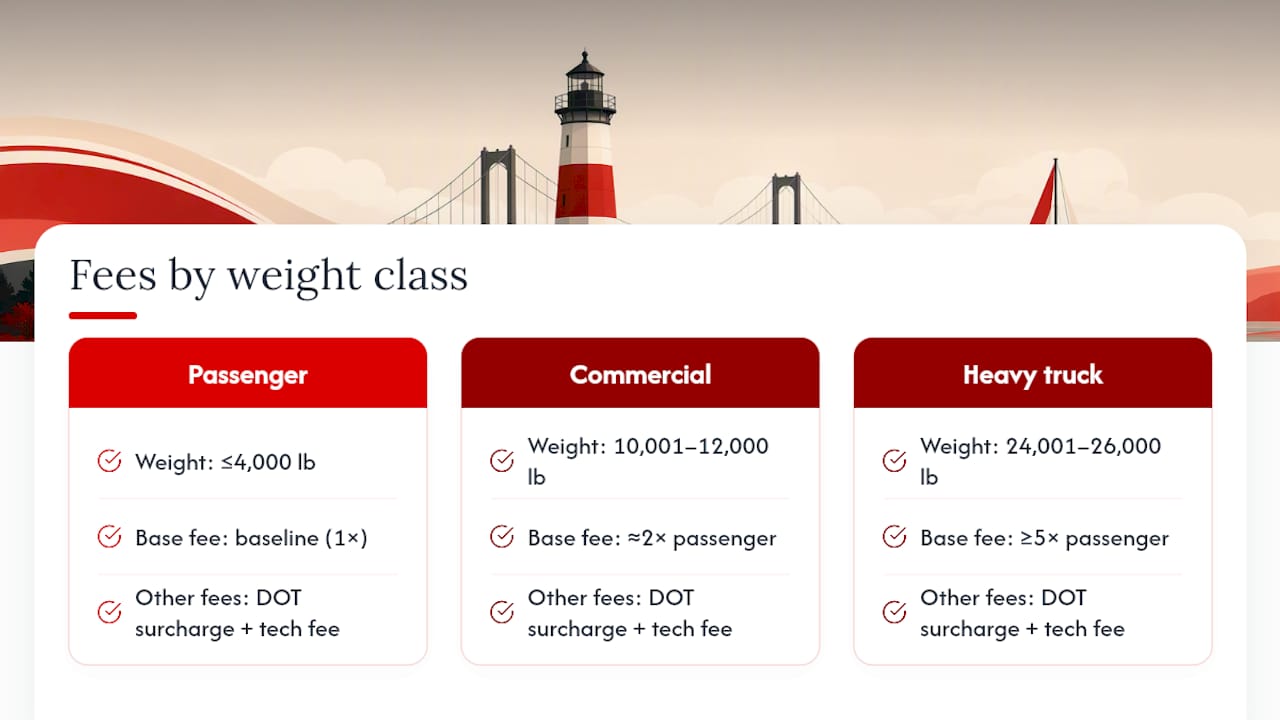
The base registration fee is tied to your vehicle's weight class. For most passenger cars, SUVs, and light trucks weighing 4,000 pounds or less, that base fee runs a set fee per year. Heavier vehicles pay more, scaled up through the RI DMV's registration-by-weight schedule.
Then there's the DOT surcharge, a fee created under the Transportation Investment and Debt Reduction Act to fund road and bridge work. As of January 1, 2026, the biennial surcharge for a standard two-year registration equals $40, or $20 per year. It stacks directly on top of your base fee.
You'll also see a flat $3.50 technology surcharge on every registration transaction, and if you pay by credit card, expect a separate vendor fee. The DMV's own fee page lists a minimum card fee of $1.55, or 2.40% for transactions of $65 or more.
Beyond the standard renewal, a handful of common transactions carry their own charges:
- Plate change (one plate): $23.50
- Vanity plate, initial passenger issue: $69.50
- Title fee (new title or transfer): $53.50
- Temporary registration and duplicate registration fees, which vary by transaction type and are listed on the DMV's plate fees page
Registration by Weight: What Your Vehicle Class Actually Costs
Finding your vehicle's gross weight is the first step to estimating your bill accurately. Check your title paperwork or the manufacturer's door placard, usually on the driver's side doorjamb, for the gross vehicle weight rating.
Once you have that number, you can match it against the DMV's published brackets. Here's how representative weight classes shake out under the current schedule, based on the official registration-by-weight PDF:
Add the $3.50 technology surcharge and any fuel-source fee on top of these totals. Commercial trucks and heavier vehicles climb steeply through the brackets, so if you're registering a work truck or trailer, the DMV's full PDF schedule is worth bookmarking rather than guessing from a table like this one.
New 2026 EV and Hybrid Fees: What Changed and Who Pays
If you're driving anything other than a gas-only vehicle, your registration bill just got a new line item. Effective January 1, 2026, Rhode Island applies annual fuel-source fees on top of standard registration costs:
- Battery electric vehicles (BEVs) have a substantial additional annual fee
- Plug-in hybrid vehicles (PHEVs) have a moderate additional annual fee
- Standard hybrids (non-plug-in) have a smaller additional annual fee
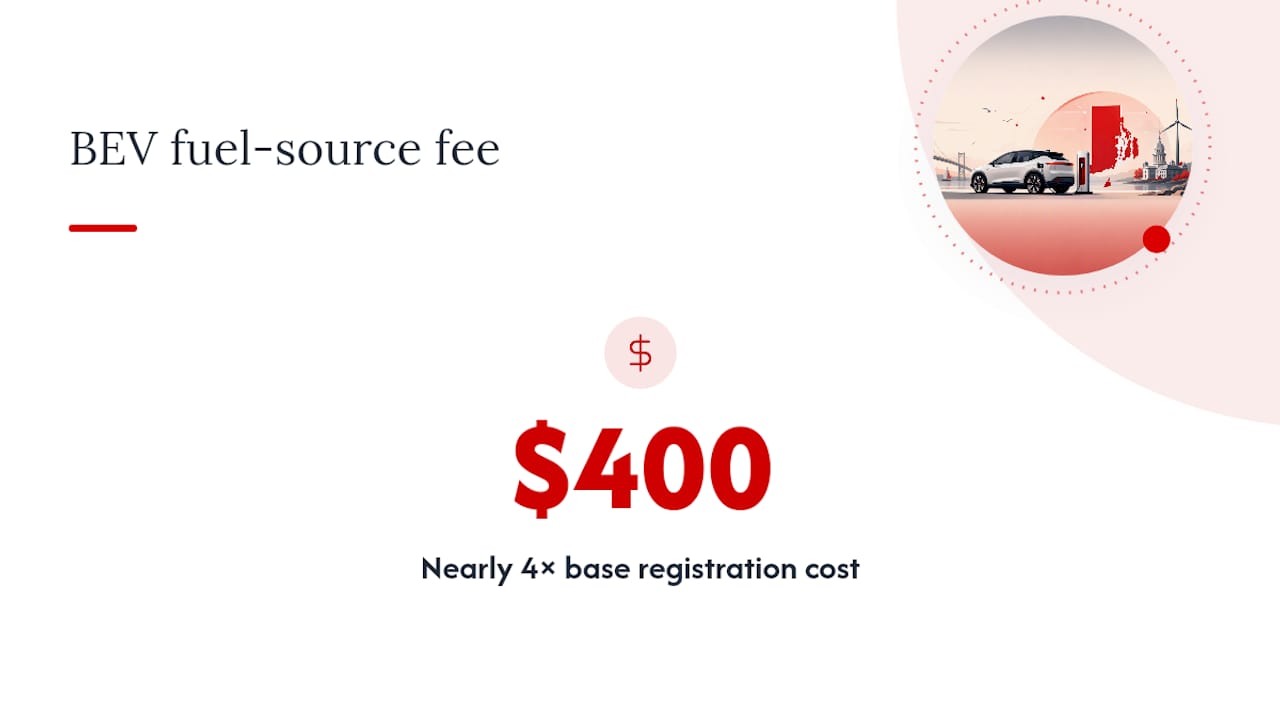
These fees are additive, not a replacement for your base fee or DOT surcharge, and they apply per registration year. So a BEV owner renewing on the standard two-year cycle pays $400 in fuel-source fees alone, stacked on top of the $60 base fee, $40 DOT surcharge, and $3.50 technology fee. Compare that to a gas-powered sedan under 4,000 pounds, which owes roughly $103.50 for the same two-year period with no fuel-source add-on.
You won't need to calculate this yourself. The DMV's system automatically applies the correct fuel-source fee based on your vehicle's fuel type once you initiate a registration or renewal transaction.
Title Fees and Sales Tax: The Costs That Hit Before You Register
Buying a vehicle triggers a separate set of obligations that land on you before your first registration renewal ever comes up.
- Title fee: $53.50 applies to new titles and ownership transfers, regardless of vehicle weight or fuel type.
- Sales tax: Rhode Island charges 7% on the purchase price for most vehicle sales, with valuation rules that differ for dealer sales versus private-party transactions, often benchmarked against NADA or Black Book values.
- Payment deadline: Tax is due by the 20th of the month following your purchase date, whether or not you've completed registration yet.
Sales tax and registration are two different obligations. Missing the 20th of the month deadline triggers penalties and interest from the Division of Taxation, even if your registration paperwork is otherwise complete.
How to Register or Renew Your Vehicle in Rhode Island
Getting through the registration counter without a second trip comes down to having the right paperwork ready. Here's the practical sequence:
- Gather your documents: the completed TR-1 application, your vehicle title, proof of Rhode Island insurance, valid identification, and lien release information if applicable. Salvage vehicles need a VIN inspection first.
- Confirm your inspection status. Rhode Island requires a passing inspection before registration in most cases, and knowing the cost ahead of time avoids a surprise at the counter, a detail covered well in Elmwood's inspection cost breakdown.
- Choose your payment method. The DMV accepts cash, money order, personal or bank checks, and credit cards, though card payments carry that vendor fee mentioned earlier.
- Decide in-person vs. mail. Some transactions, like straightforward renewals, may be handled without an office visit, but new registrations, title transfers, and plate changes typically require in-person processing or supporting documentation by mail.
- Handle common transactions separately if needed. Plate changes, temporary registrations, and duplicate registration requests each carry their own fee, so confirm the exact charge for your specific transaction at the DMV counter.
Pro Tip: If you can't get to the DMV before the sales tax deadline, pay the Division of Taxation directly at tax.excise@tax.ri.gov or 401-574-8955. That single call can save you from penalty and interest charges even before your registration is finalized.
Late Registration Fees and Penalties
Letting your registration lapse costs more than the inconvenience of a trip to the DMV. Rhode Island treats an expired registration as a moving violation risk. Driving with an expired sticker can result in a citation from law enforcement, separate from any fee owed to the DMV, and insurance complications can follow if your coverage lapses alongside your registration.
On the fee side, renewing late doesn't erase what you owe. You'll still pay the full base fee, DOT surcharge, technology fee, and any applicable fuel-source fee for the vehicle. Rhode Island does not prorate registration downward for a late renewal. If your registration expired and you were pulled over or ticketed for it, that citation is handled through the courts and carries its own separate fine structure, distinct from the DMV fee schedule.
The safest habit is treating your renewal notice like a bill with a hard due date, not a suggestion. Rhode Island's biennial cycle means you only deal with this once every two years for a standard passenger vehicle, so missing the window tends to happen when people forget the two-year gap ever passed. Setting a calendar reminder tied to your specific renewal month solves this more reliably than depending on a mailed notice to arrive on time.
Fee Variations for Commercial Vehicles and Specialized Registrations
Commercial vehicles don't follow the same flat fee structure passenger cars do. Because Rhode Island's registration-by-weight schedule scales the base fee upward as gross vehicle weight increases, a delivery van or box truck in the 10,001 to 12,000 pound bracket pays roughly double what a standard sedan owes, and a heavy truck in the 24,001 to 26,000 pound range pays five times as much or more, as shown in the DMV's weight-based fee table.
Specialized plates add another layer of cost. Vanity plates carry an initial issuance fee of $69.50 for passenger vehicles, separate from the standard registration total, and plate changes run $23.50 per plate. Trailers, motorcycles, and antique or vintage vehicle registrations each follow their own fee logic rather than the standard passenger schedule, so if you're registering anything outside a typical car, SUV, or light truck, checking the specific category on the DMV's fee pages before you budget saves you from an inaccurate estimate.
Commercial operators should also expect that the DOT surcharge and technology fee still apply regardless of weight class. Those two charges are consistent across nearly every registration type in Rhode Island, only the base fee shifts with vehicle weight or class.
Exemptions and Fee Waivers: Who Qualifies for Reduced Costs
Rhode Island doesn't offer broad, blanket exemptions from standard registration fees for most vehicle owners, but certain categories do qualify for adjusted treatment. Vehicles owned by government entities, certain nonprofit organizations, and some disabled veteran registrations can qualify for reduced or waived fees under specific statutory criteria, though the qualifying paperwork and proof requirements are strict.
Active-duty military members stationed outside Rhode Island sometimes qualify for deferred registration timelines rather than a fee waiver outright, since the underlying obligation to register typically remains once the vehicle returns to active use in the state. If you believe you qualify for an exemption category, the safest approach is confirming directly with the DMV before assuming a reduced total, since misapplying an exemption can create a bigger paperwork problem later than simply paying the standard fee upfront.
There's no current exemption carved out for electric or hybrid vehicles under the new 2026 fuel-source fees. Those charges apply uniformly to qualifying vehicles regardless of the owner's other exemption status, since they're structured as a separate statutory fee rather than part of the base registration calculation.
Our Take: Why the 2026 Fee Changes Matter More Than They Look
The conventional read on Rhode Island's 2026 fee changes treats them as a minor line-item bump, a few extra dollars here, a surcharge adjustment there. That undersells what's actually happening for EV and hybrid owners specifically. A BEV owner now pays $400 in fuel-source fees over a two-year cycle, which is nearly four times the base registration cost of a comparable gas vehicle. That's not a rounding error. It's a meaningful shift in the total cost of EV ownership that buyers researching electric vehicles rarely factor into their purchase math, focused instead on fuel savings and tax credits.
What buyers consistently underestimate is how additive these fees really are. Nothing on this list replaces anything else, every surcharge stacks on the last one. If you're weighing a used hybrid against a comparable gas vehicle, the honest comparison includes that annual fuel-source fee stretched across your expected ownership period, not just the sticker price and fuel economy numbers.
Elmwood's used car buying checklist for Rhode Island and sales tax guide exist to help you run those numbers before you sign anything, not after. We're not the DMV, and the DMV's own pages remain the legal authority on what you'll owe. But knowing the math ahead of a purchase puts you in a stronger position at the negotiating table.
— Elmwood
Get Help With the Paperwork, Not Just the Purchase
This dealership isn't a substitute for the DMV, but can help you walk in prepared instead of guessing. A low-pressure, commission-free approach means there is no rush toward a sale that leaves you stuck with fee surprises later. Every vehicle listed goes through a thorough inspection before sale, and staff help you understand what you'll owe in title fees, sales tax, and registration costs before you drive off.
If financing is part of your plan, our Used Car Financing options cover a range of credit histories, including buy here, pay here solutions for buyers who've struck out elsewhere. Trading in an old vehicle? Our trade-in program can offset your new purchase before tax and title costs even come into play.
Here's a quick snapshot of typical DMV costs to budget after purchasing a used vehicle:
| Cost Component | Typical Amount |
|---|---|
| Title fee | $53.50 |
| Base registration (4,000 pounds or less lbs) | $30 per year |
| DOT surcharge | $20 per year |
| Technology surcharge | $3.50 |
Ready to find your next vehicle? Use our Car Finder tool to search current inventory, or book a test drive and let our team walk you through the paperwork side before you head to the DMV.
FAQ
How Much Will It Cost to Register My Car in Rhode Island?
For a standard passenger vehicle under 4,000 pounds, expect roughly $103.50 for a two-year registration, covering the $60 biennial base fee, $40 DOT surcharge, and $3.50 technology fee, according to the RI DMV's fee page. Electric and hybrid vehicles add an annual fuel-source fee on top of that total starting in 2026.
What States Have the Most Expensive Registration Fees?
Registration costs vary widely by state and depend on factors like vehicle weight, local surcharges, and whether the state ties fees to vehicle value rather than a flat schedule. Rhode Island's fees sit in a moderate range nationally, though the new 2026 fuel-source fees for EVs and hybrids do increase the total for those specific vehicle owners.
Can I Register a Car in Rhode Island With an Out-Of-State License?
Yes, you can register a vehicle in Rhode Island while holding an out-of-state driver's license, though the vehicle itself typically needs Rhode Island insurance and must pass state inspection requirements. If you're establishing residency, the DMV generally expects you to transfer your license within a defined window after moving.
Do You Have to Register Your Car Every Year in RI?
No, most passenger vehicles in Rhode Island renew on a biennial cycle, meaning you register once every two years rather than annually. Commercial vehicles and certain specialized registrations may follow different renewal timelines, so check your specific vehicle classification with the DMV.