
To complete a Rhode Island title transfer, you pay any sales tax owed and file for a new title using Form TR-2/TR-9 (or TR-1 if you're only registering). New residents are required to complete this within a limited time after moving to Rhode Island. Bring a signed title or proof of ownership, a bill of sale, proof of Rhode Island insurance, a photo ID, and a VIN inspection if the car came from out of state.
TL;DR:
- Out-of-state vehicles require a VIN inspection from a municipal police department before Rhode Island will issue a title, and the inspection is valid only for a limited time.
- A non-titled vehicle needs a stamped sales tax form or old registration instead of a title, along with the standard TR-2/TR-9 application and proof of sale.
- The fee for a prior non-titled vehicle's title is $53.50, and sales tax must be paid at the time of transfer regardless of registration timing.
- In-person VIN inspections are necessary for out-of-state used vehicles, and it is best to schedule and complete inspections within the same week as filing at the DMV.
- Private-party sellers must sign over the title correctly and provide a bill of sale, while dealers handle most paperwork on behalf of buyers, including lien payoffs.
Table of Contents
- What Documents Do You Need for a Rhode Island Title Change?
- How Do You Transfer a Title in Rhode Island?
- What Are the Rhode Island Title Transfer Fees?
- Do Out-of-State Vehicles Need a VIN Inspection in Rhode Island?
- What About Liens, Duplicate Titles, and Salvage Vehicles?
- Elmwood's Take: What Actually Slows Down a Title Transfer
- Need Help With the Paperwork? Come Talk to Us First
- Sources
What Documents Do You Need for a Rhode Island Title Change?
The paperwork you need depends on whether the vehicle already has a title. For most transactions, you'll fill out TR-2/TR-9, the official application for title. If you're also registering the car in Rhode Island, you'll add TR-1 to the stack, and if sales tax applies, you'll need the T-334 use tax form. All three are downloadable directly from the RI DMV site.
A titled vehicle needs the original title, signed over by the seller. A previously non-titled vehicle, like an older car that never had a Rhode Island title, needs a stamped paid sales tax form or old registration instead, along with TR-2/TR-9.
Beyond the forms themselves, plan to bring:
- A valid photo ID
- Proof of Rhode Island residency
- Proof of active Rhode Island insurance
- A signed bill of sale showing the purchase price
- A lien release, if a bank or credit union held the previous title
- Notarized signatures, when the DMV requires them for duplicate or corrected titles
Pro Tip: Download every form straight from dmv.ri.gov instead of a third-party paperwork site. Unofficial sites sometimes list outdated fees or missing signature lines, which is one of the fastest ways to get your application bounced back.
How Do You Transfer a Title in Rhode Island?
The process looks a little different depending on how you got the car. Here's how it breaks down for the three situations most Rhode Islanders run into.
Private-party sale:
- The seller signs the title over to you, filling in the sale price and date.
- You complete TR-2/TR-9 and, if tax is owed, the T-334 use tax form.
- You pay any sales tax due at the time of filing.
- You submit everything to the DMV, either in person or by mail.
- If the car came from another state, you'll need a VIN check from your local municipal police department before the DMV will process the title.
Dealer sale: Dealerships typically manage most of this paperwork on your behalf, including preparing the title assignment and handling lien payoffs on trade-ins. Even so, you still need to:
- Confirm the title assignment is filled out completely and correctly
- Bring your own proof of Rhode Island insurance
- Present valid photo ID at signing
New Rhode Island resident with an out-of-state vehicle: You have 30 days from your move to get a Rhode Island title and registration, and you need Rhode Island insurance in place before you file. Schedule your VIN inspection early since it has to happen before the DMV will accept your application. Bring your out-of-state title or registration, your new insurance card, and ID. Mail-in filing works fine for straightforward tax-and-title transactions, but anything involving a VIN inspection usually means at least one in-person stop.
What Are the Rhode Island Title Transfer Fees?
Title fees are modest compared to what you'll pay in sales tax, but they still catch people off guard. Rhode Island charges a title fee for previously non-titled vehicles, and the DMV's own fee table lists other charges that can apply depending on your situation.
- A previously non-titled vehicle carries a title fee of $53.50, a figure the DMV cites directly as an example.
- Sales tax is due at the time of purchase, separate from the title fee, and you owe it whether or not you register the car right away.
- Mail-in applications go to the DMV Research Office at 600 New London Ave., Cranston, RI 02920.
- Duplicate title requests can only be processed in person at that same Cranston location.
Filing before you drive matters here, since Rhode Island law treats a transfer as incomplete until the assignment and application steps are actually filed, not just signed.
Do Out-of-State Vehicles Need a VIN Inspection in Rhode Island?
Yes. Any out-of-state used vehicle needs a VIN check from a local municipal police department before the DMV will issue a Rhode Island title. This isn't a DMV function. It's handled by police departments, so you'll want to call ahead and confirm hours rather than showing up unannounced.

What you bring depends on where the car came from. If the previous state issued a title, you need that original title, properly signed over to you. If the vehicle came from a state that didn't title it, an old registration or a stamped paid sales tax form will usually work instead.
A few things that save you a second trip:
- Bring the vehicle itself. Most departments need to physically check the VIN against the frame.
- Bring your current registration or title and a photo ID.
- Call the department first. Some Rhode Island municipalities only run inspections on certain days or by appointment.
Pro Tip: Get the VIN inspection done in the same week you plan to file at the DMV. Inspection paperwork is only good for a limited window, and letting it sit too long means you'll be back at the police department for a redo.
What About Liens, Duplicate Titles, and Salvage Vehicles?
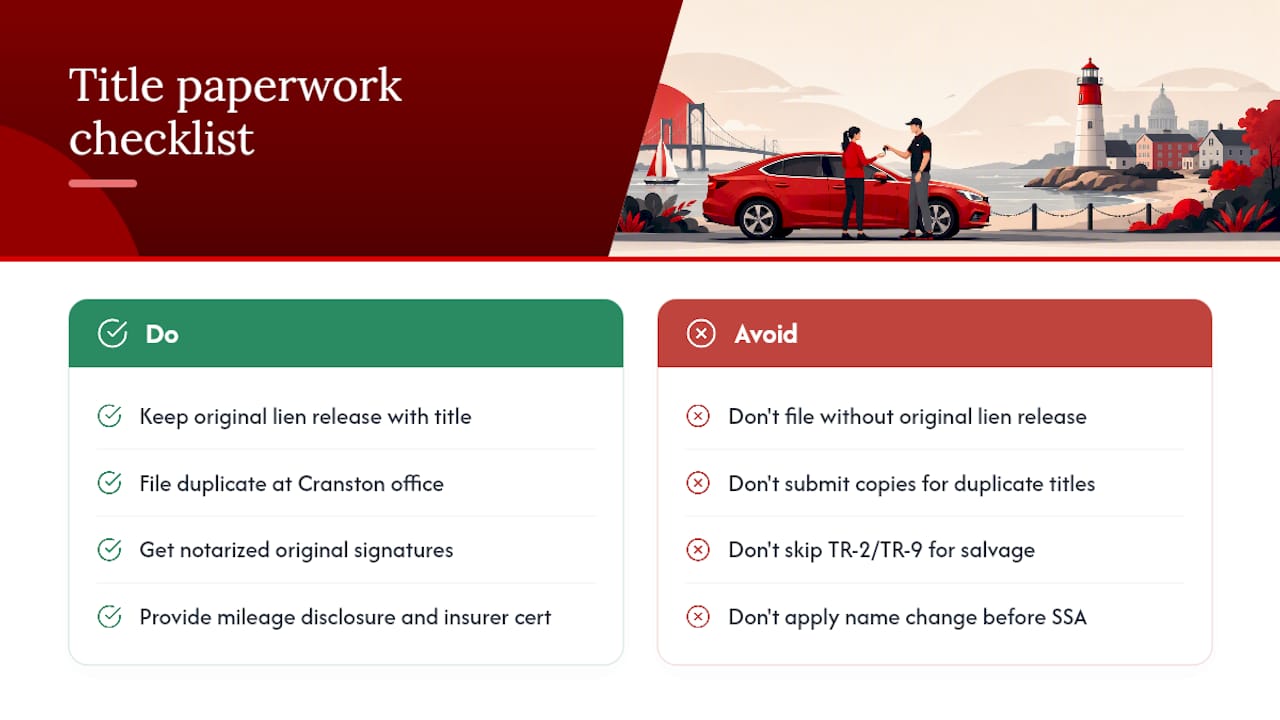
A satisfied lien doesn't require you to file for a brand-new title. Rhode Island only needs an original lien release or the lienholder's signature on the existing title, which you should keep with the title itself going forward.
Duplicate titles are handled only at the Cranston Research Office, and they typically require notarized, original signatures rather than copies. Salvage and reconstructed vehicles carry stricter documentation requirements, including mileage disclosures and insurer certificates, and the TR-2/TR-9 instructions spell out exactly what's needed case by case.
Name changes have their own order of operations: update the Social Security Administration first, then bring the original title in your previous name along with the required DMV forms. Skipping the SSA step is a common reason applications get rejected.
Elmwood's Take: What Actually Slows Down a Title Transfer
Most delays we see at the dealership have nothing to do with the DMV being slow. They come from buyers showing up without a lien release, or private-party sellers signing a title incorrectly before the sale even closes. When you buy through us, we coordinate the paperwork, handle lien payoffs on trade-ins, and make sure the title assignment is filled out right the first time.
That said, you still need to bring your own insurance and ID, and it's worth confirming who's mailing what before you leave the lot.
— Elmwood
Need Help With the Paperwork? Come Talk to Us First
Buying from a dealer changes the math on title transfers considerably. When you buy a vehicle at Elmwood Auto Sales, we coordinate the title assignment, handle lien payoffs, and walk you through the exact documents you'll need to bring to the DMV, so you're not deciphering forms on your own kitchen table.
Self-service filing is always an option if you'd rather handle it yourself, and everything above will get you there. But if you'd rather have someone double-check the paperwork before it reaches the DMV, schedule a test drive and ask our team about title and registration support while you're here. It's a straightforward way to buy your next car and roll the paperwork into the same visit.