
Rhode Island charges a flat 7% sales and use tax on most passenger vehicle, motorcycle, and motor home purchases, and the buyer, not the dealer, is on the hook for paying it. That payment is due before you register the car or by the 20th day of the month following your purchase date, whichever applies to your situation. Private sales get taxed a little differently than dealer sales, and family gifts, trade-ins, and older vehicles all carry their own rules that can raise or lower what you actually owe.
TL;DR:
- Buyers of private-party cars must check NADA values for vehicles under seven years old, as tax is based on the higher of sale price or NADA value.
- Trade-ins, family gifts, and certain organization transfers can reduce or eliminate the 7% tax if proper documentation is provided before registration.
- The deadline for paying the sales tax is before registration or by the 20th day post-purchase; late payments incur interest and penalties.
- Buyers can request a review of the assessed value within 30 days if they believe their vehicle was taxed on an inflated valuation, using proper evidence.
- Dealer purchases generally involve straightforward 7% tax calculation, with the dealer managing paperwork, but the buyer remains responsible for ensuring timely payment.
Table of Contents
- Rhode Island Sales Tax Cars: Dealer Purchases and What to Expect
- Private-Party Sales: Why NADA Values Can Surprise You
- Trade-Ins, Family Gifts, and Other Tax Exemptions
- Paying the Tax: DMV Deadlines and What Happens If You're Late
- Disputing the Valuation: How the Redetermination Process Works
- CPI Vehicles and Cars 30 Years or Older
- Elmwood's Practical Checklist for a Smooth Tax and Registration Process
- Why the State Puts the Burden on You, Not the Dealer
- Elmwood Auto Sales: Skip the Valuation Guesswork
- Sources
Rhode Island Sales Tax Cars: Dealer Purchases and What to Expect
When you buy from a licensed dealer, the math is usually straightforward: Rhode Island applies 7% to the purchase price, with no city or county tax stacked on top the way some states do it.. If you're trading in a qualifying private passenger vehicle, that trade-in value gets subtracted from the sale price before the tax is calculated, which can shave a real amount off your bill on a higher-value trade.
Dealers handle most of the mechanics for you. They typically prepare a Dealer's Statement of Sale, known as form T-336-1, which functions as your purchaser's tax return and gets filed with the state on your behalf. That said, the legal responsibility for making sure the tax gets paid still rests with you as the buyer, not the finance office.
Before you leave the dealership, make sure you walk out with:
- A signed bill of sale showing the final purchase price
- Documentation of your trade-in, including its stated value
- Complete financing paperwork if you're not paying cash
- A copy of the T-336-1 or equivalent tax filing the dealer submits
Hold onto every one of these. You'll need most of them again when you register the vehicle at the Rhode Island DMV.
Private-Party Sales: Why NADA Values Can Surprise You
Buying from a private seller changes how Rhode Island calculates what you owe, and it catches a lot of buyers off guard. The state doesn't simply tax whatever number you and the seller agreed on if that number looks low compared to the vehicle's market value.
- Vehicles seven years old or newer. Rhode Island taxes these at 7% of whichever is higher: the NADA Clean Retail value or the actual sale price. If you negotiate a great deal on a three-year-old sedan, the DMV can still calculate your tax based on the higher NADA figure.
- Vehicles 8 to 29 years old. As long as the vehicle isn't on the Cars of Particular Interest list, tax is based on the actual sale price you paid, not a book value.
- What this means in practice. A buyer who pays $6,000 for a six-year-old SUV that NADA values at $9,500 will likely owe tax on the $9,500 figure, not the $6,000 they actually spent.
Before you hand over cash for a private sale, look up the NADA Clean Retail value yourself. Bring the bill of sale, the title, and proof of the agreed price to the DMV. If the numbers don't match what you expected, you'll at least know why going in.
Trade-Ins, Family Gifts, and Other Tax Exemptions
Not every vehicle transfer in Rhode Island triggers the full 7%. A few common situations reduce or eliminate the tax entirely, provided you have the right paperwork.
- Trade-ins. The value of a qualifying passenger vehicle traded toward a new purchase reduces your taxable amount dollar for dollar, per state regulations on trade-in allowances.
- Immediate-family gifts. Transferring a car between a parent, child, spouse, or sibling can qualify for exemption, but you'll need a signed letter of gift or a notarized affidavit confirming no money changed hands.
- Government and nonprofit transactions. Certain sales to or from exempt organizations may skip the tax, though eligibility depends on the specific entity and transaction type.
Pro Tip: If you're gifting a car to a family member, get the notarized affidavit done before you go to the DMV. Showing up without it means you'll likely be sent home to redo the paperwork, and that delay can push you past the payment deadline.
Paying the Tax: DMV Deadlines and What Happens If You're Late
You have two practical options for paying: settle the tax directly with the Division of Taxation ahead of time, or pay it at the DMV when you title and register the vehicle. Most buyers handle it at the DMV counter since it's one stop for both steps.
The deadline is firm: payment is due before registration, or by the 20th day of the month following your purchase date, whichever applies to your situation. Miss that window and the state adds interest and penalty charges on top of what you already owe, and those charges accrue the longer the balance sits unpaid.
Before you head to the DMV, have these ready:
- Signed bill of sale with the purchase date clearly stated
- Title or manufacturer's certificate of origin
- Valid photo identification
- Proof of insurance for the vehicle
Buyers routinely assume the dealer's paperwork automatically satisfies the state, but the purchaser carries the actual legal obligation to see the tax paid on time, even when a dealer prepared the filing.
Disputing the Valuation: How the Redetermination Process Works
If you believe the state taxed your vehicle based on an inflated NADA or CPI value, you're not stuck with that number. Rhode Island allows a redetermination request, but the window is short.
- File within 30 days. You have 30 days from the date you paid the tax to request a review of the assessed retail value.
- Submit the right form. The Division of Taxation provides specific appeal forms for this process, and they need to go to the Division directly, not the DMV.
- Bring evidence. Comparable sales listings, an independent appraisal, or documented vehicle condition issues all strengthen your case. A bare assertion that the price "felt too high" rarely moves the needle.
Gathering that evidence before you pay, rather than scrambling after, puts you in a much stronger position if you already suspect the valuation will be disputed.
CPI Vehicles and Cars 30 Years or Older
Certain models sold privately fall under Rhode Island's Cars of Particular Interest list, commonly called CPI. These are typically collectible or specialty vehicles where a standard NADA figure wouldn't reflect the real market, so the state uses separate CPI book values to set the taxable amount instead.
- Vehicles on the CPI list get taxed using that specific CPI value rather than standard NADA Clean Retail figures.
- Vehicles 30 years old or older often carry unique valuation considerations, and documentation like restoration records or prior appraisals can help support the number you report.
- For vehicles outside the CPI list in the 8 to 29 year range, sale price still governs, so the interplay mostly matters for classic and specialty cars.
If you're buying anything that might qualify as a collector vehicle, check the CPI list before you finalize a price.
Elmwood's Practical Checklist for a Smooth Tax and Registration Process
Every vehicle we sell at Elmwoodautosalesri goes through a thorough inspection before it reaches the lot, and that same attention to detail carries over into how we handle paperwork. A clean trade-in valuation and accurate sale documentation up front means fewer questions later when you're standing at the DMV counter.
For any purchase, whether through a dealer or a private seller, keep this checklist handy:
- Signed bill of sale with the exact purchase date
- Title or certificate of origin
- Government-issued photo ID
- Proof of insurance
- Trade-in documentation, if applicable
- Complete financing paperwork
If you're buying privately, get a written receipt regardless of how well you know the seller, note the exact odometer reading at the time of sale, and keep copies of everything. Check NADA or CPI values before you agree on a price rather than after, since that single step prevents most of the tax surprises buyers run into.
Why the State Puts the Burden on You, Not the Dealer
Most buyers assume that once they sign paperwork at a dealership, the tax question is someone else's problem. It isn't, and that gap between expectation and reality is where a lot of avoidable stress comes from.
Rhode Island's structure makes sense once you understand the incentive behind it. Dealers file the T-336-1 and handle the mechanics, but the state wants a legal backstop that doesn't depend on a third party getting every filing right. Putting the obligation on the purchaser means the state always has someone to collect from, regardless of clerical errors on the dealer side.
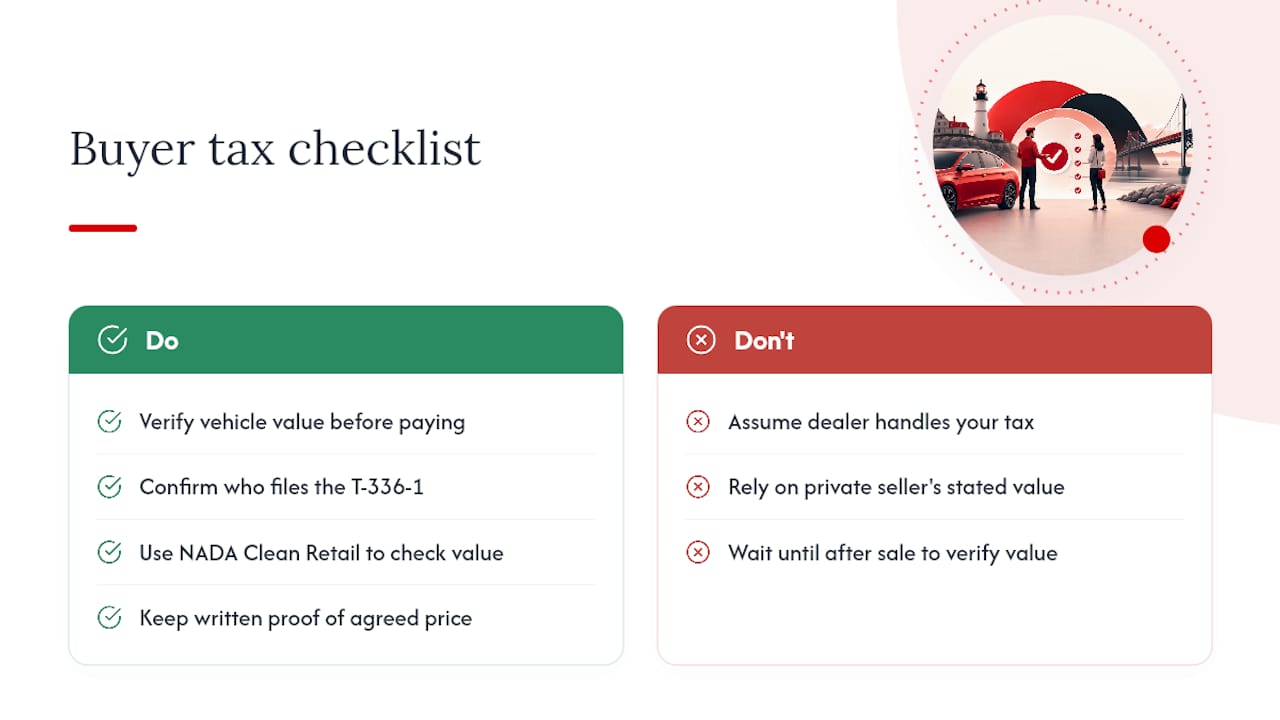
The private-sale valuation rules get more criticism than they deserve, in our view. Buyers often treat the NADA Clean Retail requirement as an unfair markup on a fair deal they negotiated. But the rule exists precisely because casual sales are the easiest place to understate a price and dodge tax on the difference. If you're getting a genuinely good deal on a private sale, the NADA check protects the honest transaction from being penalized alongside the dishonest ones.
Where the system falls short is transparency at the point of sale. Nothing forces a private seller to tell a buyer that the state might tax them on a higher book value than the agreed price. That's a gap buyers have to close themselves, by checking values before they hand over money, not after.
— Elmwood
Elmwood Auto Sales: Skip the Valuation Guesswork
Buying through a licensed dealer removes most of the uncertainty that trips up private-sale buyers. Every vehicle on a dealer's lot is ideally inspected, and tax paperwork and trade-in documentation are prepared to align with state expectations.
Tailored financing options are available to buyers with a range of credit histories, helping the paperwork side of your purchase move smoothly. If you're weighing a dealer purchase against a private sale, come see what a reliable used car dealer in Providence can do for your timeline and your budget. Schedule a test drive today and let us walk you through the registration paperwork before you ever set foot in the DMV.
Sources
- Sales & Use Tax — Rhode Island Division of Taxation
- Sales tax — Rhode Island Division of Motor Vehicles
- 280 R.I. Code R. 280-RICR-20-70-28 - Payment of Tax as Prerequisite to Registration