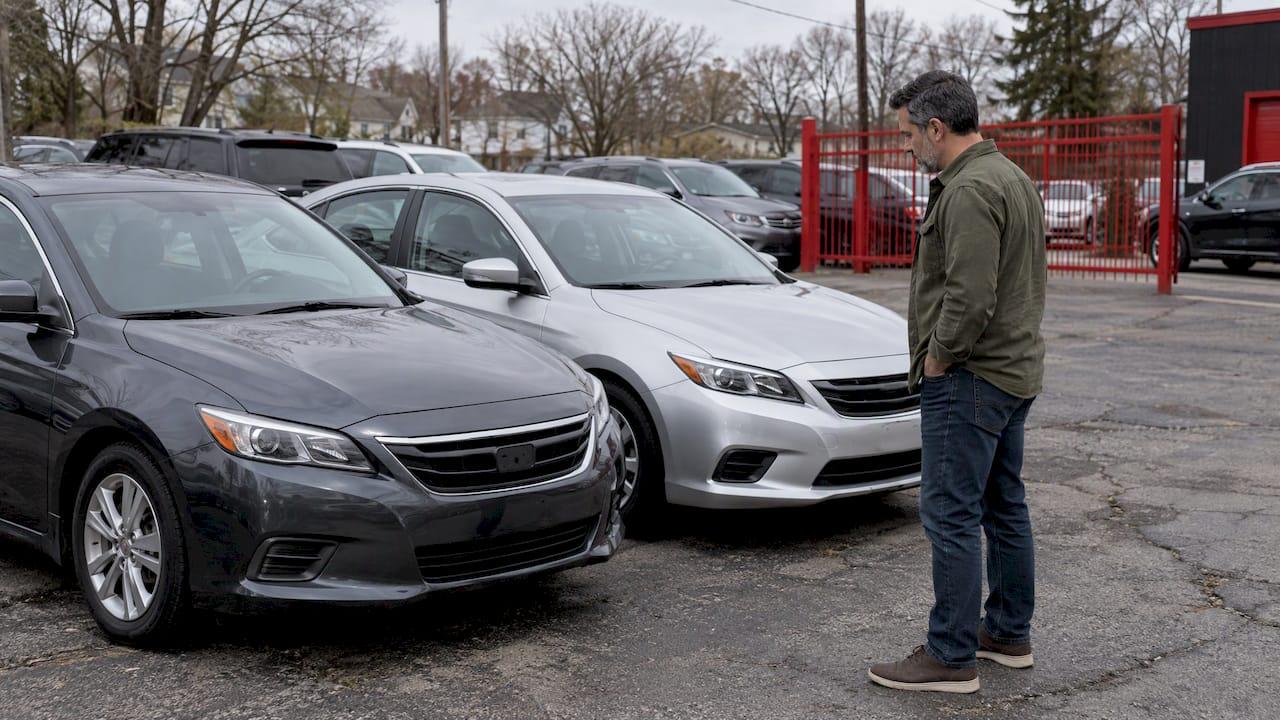
Neither label decides it. A one-owner car was titled to a single registrant, and a fleet car was used by a business, agency or rental company. Neither fact alone tells you how well the car was treated. The better buy is the one with documented maintenance, a clean title, honest mileage and a fair price, whichever label it carries. This guide explains what each term means, how the two tend to differ, and how to check a specific car before you sign.
TL;DR
- "One owner" means one registrant on the history report. It does not mean one driver, and it does not mean the car was serviced on time.
- A fleet car was owned or leased by a company, agency or organization. Some fleets keep strict service schedules, while rentals and some government vehicles can be driven hard.
- Experian's own analysis found rental use had virtually no effect on longevity, while police, taxi or government use usually lowered the score.
- Check the registration history, service records, title and recalls, and get a pre-purchase mechanic's inspection on any used car.
- Compare the ownership pattern with the car's mileage, condition and asking price, not with the label.
Table of Contents
- What does "one owner" mean on a used car?
- What is a fleet car?
- How do one-owner and fleet cars compare?
- Which one was driven harder and maintained better?
- Are one-owner cars more reliable than fleet cars?
- How do you read the ownership details on a history report?
- What does the one-owner label do to price?
- What should you check before buying a one-owner or fleet car?
- Which should you choose if you are shopping in Rhode Island?
- Looking for a used car in Providence?
- FAQ
- Sources
What does "one owner" mean on a used car?
A one-owner designation means the VIN has been titled to a single registrant since it left the dealership. That registrant can be a person, a couple, or a business. The label says nothing about how many people drove the car or whether the oil was changed on schedule.
The count is also less exact than it sounds. Carfax describes an owner as an individual or business that possesses and uses a vehicle, and its count is an estimate drawn from all the events in the vehicle's history, not a simple tally of title transfers. That estimate is available for vehicles manufactured after 1991 and titled in the US.
Two examples show how the number can mislead:
- A car leased for three years and then bought by the lessee at lease-end may show two owners, the leasing company and the individual, even though only one person ever drove it.
- A car that a fleet company rotated among dozens of drivers can show one owner, because only one entity held the title.
So "one owner" is a useful starting point. It is not a quality grade.
What is a fleet car?
A fleet vehicle is an automobile owned or leased by a company, agency or organization for work purposes rather than household driving. The difference from personal use is function, not condition.
On a vehicle-history report, the wording varies. AutoCheck's glossary defines "Fleet, Rental and/or Lease Use" as a report that the vehicle was used in one of those ways, and it keeps title brands such as salvage and rebuilt as a separate category. It also defines commercial use as a vehicle registered and used for business, such as a delivery truck, taxi or rental car, and government use as use by a government agency.
In practice, fleet cars fall into a few groups:
- Rental cars. Dozens or hundreds of drivers over a short period.
- Corporate cars. Usually one consistent driver, such as a sales representative.
- Government and utility vehicles. These range from administrative sedans to police cruisers and utility trucks.
- Service vans and delivery trucks. Work vehicles used for business routes.
Lumping them together is the first mistake buyers make. A former sales-team sedan with a documented service history and a former police cruiser are both "fleet," and they are very different used cars.
How do one-owner and fleet cars compare?
Here is a side-by-side view of what each label can and cannot tell you.
| Question | One-owner car | Fleet car |
|---|---|---|
| Who held the title? | One person, family or business | A company, agency, rental or leasing entity |
| Number of drivers | Often one or two, but not guaranteed | One (corporate) to hundreds (rental) |
| Records | Fewer ownership changes can mean fewer lost records | Often scheduled and consistent, depending on the fleet |
| Typical wear risk | Depends entirely on the owner | Depends on fleet type: rental, police and taxi differ from corporate |
| What the label proves | One registrant | Business, rental, lease or government use |
| What to read next | Registration history and service records | Fleet type, service records and mileage |
The bottom row matters most. In both cases the label opens a question. The records answer it.
Which one was driven harder and maintained better?
There is no universal answer, but there are patterns worth knowing.
One-owner status can make a car's history easier to follow and may make complete records more likely, because fewer ownership changes mean fewer chances for paperwork to be lost or maintenance to be deferred. It is not a quality certification.
Fleet histories vary a great deal. Rentals can carry high mileage and wear from many drivers, while some fleets follow scheduled maintenance and keep service records. Fleet operators commonly rely on preventive maintenance because vehicle downtime is costly, and their service can be documented more consistently than a private owner's. Fleet ownership alone does not establish abuse or poor upkeep.
What a well-kept fleet record looks like on paper: oil changes at regular intervals of roughly 5,000 to 7,000 miles, entries from the same service provider or dealership, and wear items such as brake pads, tires, filters and batteries replaced at predictable points.
A private one-owner car can look the opposite. A single owner who skipped services and drove short trips in stop-and-go traffic can leave a car in worse shape than a multi-owner car with steady service. The ownership count affects how a car is perceived and priced, but it does not reliably predict mechanical condition.
Are one-owner cars more reliable than fleet cars?
Not necessarily. Ownership history gives context for judging risk. It does not prove how the vehicle was treated.
Experian's AutoCheck Score white paper gives a helpful data point. Its analysis found that rental usage had virtually no impact on vehicle longevity, that police, taxi or government use usually lowered the score, and that off-lease vehicles showed increased longevity. Those are the findings of one scoring model, not a promise about any individual car, but they support the same point: the type of fleet use matters more than the word "fleet."

For a buyer, that translates into a simple rule. Treat "fleet" as a prompt to ask which kind. Treat "one owner" as a prompt to ask who, and for what use.
How do you read the ownership details on a history report?
A vehicle-history report can show ownership count, title and registration events, odometer entries, reported accidents or damage, and title brands. But reports depend on supplied records and may be incomplete, so a clean report is a good sign, not a guarantee.
When you read one, look at these lines together:
- Owner count and owner type. One owner is a starting point. Note whether the report flags personal, lease, rental, commercial or government use.
- Registration history. The owner count and the registration history are separate fields on a report. Where the car was registered, for how long, and whether the address changed can tell you far more about use than the count does.
- Odometer entries. Check that readings rise steadily over time, with no unexplained jumps backward.
- Title and damage entries. Look for brands such as salvage or rebuilt, which AutoCheck treats separately from fleet use.
- Service entries. Regular entries at similar intervals are the best sign of steady care, whether the car is one-owner or fleet.
If you want a walkthrough, our guide on how to read a Carfax report with VIN, invoice and recall checks covers each line in order. We also explain why we provide free vehicle history reports on the cars we sell, so you can review the ownership entries yourself before you visit.
One limit applies to fleet cars specifically. A report may not confirm which business a vehicle was registered to. Carfax Canada, for example, says it cannot confirm the specific business or type of business and suggests asking the seller or the registration authority. In the US, the practical step is the same: ask the seller what the fleet use was, and ask for the service records that go with it.
What does the one-owner label do to price?
One-owner cars are often listed at a premium, because shoppers read the label as a sign of care. That makes the label worth verifying before you pay for it. A buyer should compare the ownership pattern with the car's condition, mileage and asking price. If a one-owner car has gaps in its service history, the label is not worth extra money. If a fleet car has full records, a fair price and a clean title, it can be the more sensible purchase, particularly for first-time buyers and budget-conscious shoppers who need dependable transportation.
Mileage and age also interact with ownership. A newer car with higher fleet mileage and an older low-mileage one-owner car can cost about the same and age very differently. Our guide to choosing mileage or age by ownership horizon helps you decide which trade-off suits how long you plan to keep the car.
How we look at it at Elmwood
We sell used cars, SUVs, trucks and vans in Providence, and the ownership label is one of the first things buyers ask us about. Our view is that the label is a reason to look closer, never a reason to decide. A one-owner car with a thin service record and a fleet car with a full one are not the same purchase, and we would rather you compare cars on evidence.
That is why we put the vehicle history report in front of you and why our process is built around thorough vehicle inspections. We do not rely on commission-based sales tactics, so there is no push toward one car over another. If a fleet vehicle with clear records fits your budget and your family's needs, we will say so. If a one-owner car suits you better, we will say that too.
For buyers with a range of credit histories, we also offer tailored financing, including buy here, pay here options, so the right car does not depend on picking the most expensive label on the lot.
Elmwood
What should you check before buying a one-owner or fleet car?
The same steps apply to both. Federal guidance on used-car buying is consistent on them.
- Get a vehicle-history report. The U.S. Department of Justice's NMVTIS buying guidance recommends an NMVTIS vehicle-history report. NMVTIS was created under the Anti-Car Theft Act of 1992 to help prevent theft and fraud by making title, brand, theft and other data available to buyers and officials.
- Check title, odometer, damage and recalls. The BBB suggests matching all VINs, reviewing title and damage information and considering NMVTIS for title, odometer and certain damage history.
- Ask for maintenance records. Request them from the owner, dealer or repair shop. For a fleet car, ask which fleet it came from and whether service was done on a schedule.
- Test-drive in varied conditions. Include city streets, a highway stretch and a few hills. Listen for noises and note how the car brakes and steers.
- Arrange an independent inspection. The FTC notes that a safety inspection is not the same as a general mechanical check. A pre-purchase mechanic's inspection is meant to assess broader mechanical condition, even when a dealer has certified or inspected the vehicle.
Our own dealership vehicle inspection process guide explains what a good inspection covers, so you know what to expect from any seller.
Extra questions for a fleet car
- Was it a rental, corporate, government or commercial vehicle?
- Do the service records show regular intervals and the same provider?
- Do the mileage and the wear on the seats, pedals and steering wheel match each other?
- Was it a work truck that towed or hauled heavy loads?
Extra questions for a one-owner car
- Does the registration history confirm personal use?
- Were services done on time, or only when something broke?
- Does the mileage fit the owner's age, location and commute?
- Is the asking price higher because of the label, and do the records justify it?
Which should you choose if you are shopping in Rhode Island?
For most buyers, the decision comes down to the records in hand. A one-owner SUV with complete service entries and a clean title is a strong choice for a family. A former corporate sedan with regular service and fair mileage can be an equally good commuter at a better price. A former rental or heavy-duty work vehicle can still be a sound purchase when it has been inspected and priced for what it is.
Rhode Island's weather adds a practical angle. Salt on winter roads makes underbody condition, brakes and tires worth a close look, and a car that spent its life in a coastal or urban fleet deserves the same check as one that sat in a private driveway. Ownership history cannot show rust or wear. Your eyes and a mechanic can.

If you are comparing several cars, our used car buying guide archive collects more checklists, and our piece on why buy a used car over new explains the value case in detail.
Looking for a used car in Providence?
At Elmwood Auto Sales, we sell inspected used cars, trucks, SUVs and vans, and we show you the vehicle history so you can judge the ownership story yourself. You can browse our current inventory or let us search for you with Car Finder.
If you need financing, our used car financing application is designed for a range of credit profiles, including buy here, pay here solutions. If you have a car to trade, you can start a trade-in or sale online.
FAQ
Is a one-owner car always better than a fleet car?
No. One owner means one registrant, not careful use. A poorly maintained one-owner car can be a worse buy than a multi-owner car with consistent service. Compare the service records, mileage, condition and price instead of relying on the label.
Are fleet cars a bad idea for first-time buyers?
Not by default. Fleet ownership alone does not establish abuse, and some fleets keep scheduled maintenance records. What matters is the fleet type, since rental, police, taxi and corporate use differ. Ask which it was, review the records, and get an independent inspection.
What does it mean when a report says fleet vehicle?
It means the report indicates the car was used as a fleet, rental or lease vehicle. AutoCheck defines commercial use as business use such as a delivery truck, taxi or rental car, and government use as use by an agency. The report may not name the business, so ask the seller.
Can a car with one owner on Carfax have had many drivers?
Yes. The count reflects who held the title, and a company can hold the title while many employees or renters drive the car. Carfax's count is also an estimate based on the vehicle's events, so read the registration history and service entries alongside it.
What is the first thing to check on either type of car?
Start with the vehicle-history report, covering title, odometer, damage and recalls, then ask for maintenance records. Federal guidance also recommends a test drive in varied conditions and an independent mechanic's inspection before you buy.
Sources
- How Many Owners by VIN: The Real Count
- Carfax sample vehicle history report
- What Is a Fleet Vehicle and How to Check If Your Car Was One
- AutoCheck glossary
- What Does Prior Use Fleet Mean on a Used Car?
- Vehicle Ownership History: What It Tells You
- AutoCheck Score White Paper
- How to Read a Used Car's Vehicle History Report
- CARFAX Canada: Fleet, rental and lease
- NMVTIS used car buying tips
- Federal Register: NMVTIS
- BBB Tip: Buying a used car
- FTC: Buying a Used Car