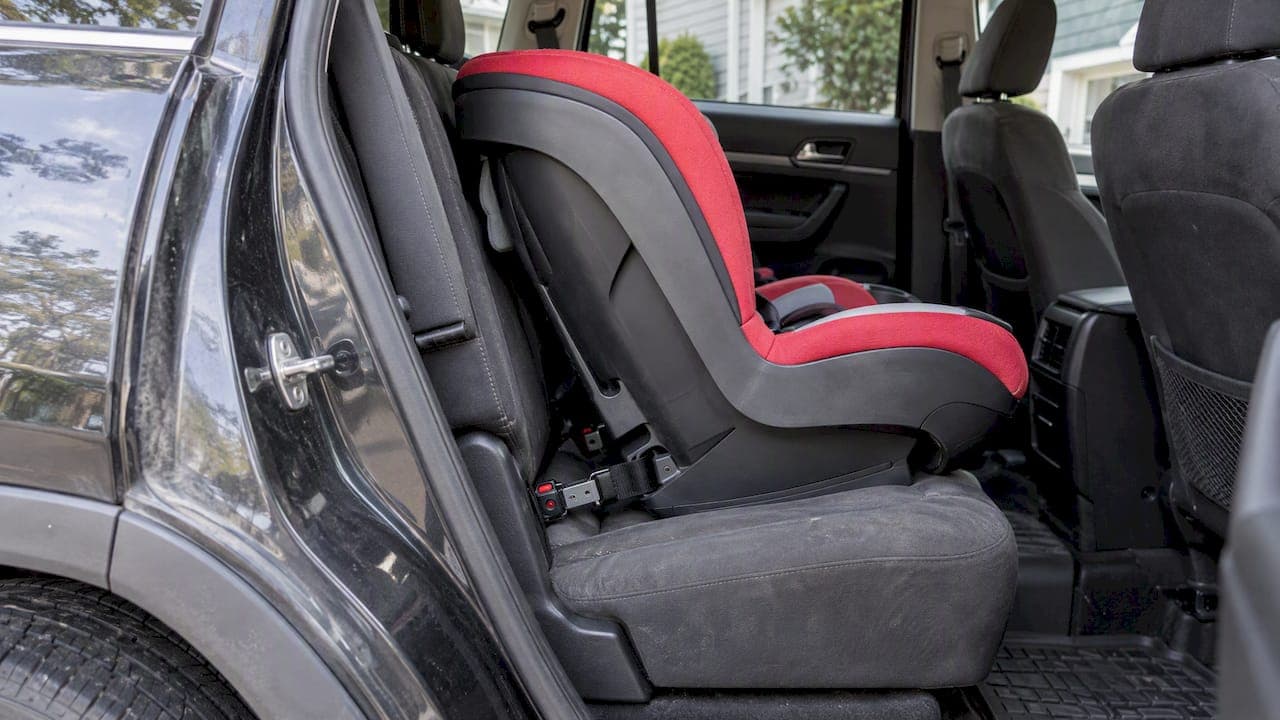
LATCH stands for Lower Anchors and Tethers for Children. It is a set of built-in metal anchors in your vehicle and matching connectors on your child's car seat, designed so you can install the seat without using the seat belt. Two lower anchors hold the base of the seat, and one top tether anchor steadies the top of a forward-facing seat. Used correctly, LATCH and the seat belt are equally safe, so the best choice is the one that gives you a tight installation in your vehicle.
This guide explains the parts, shows you where to find them, covers weight limits and the tether, and ends with what to check when you shop for a used SUV or truck for a growing family.
TL;DR
- LATCH has three parts: two lower anchors in the seat bight and one top tether anchor. The tether is for forward-facing seats.
- LATCH and seat belt installations are considered equally safe. Pick whichever gives you a tight, secure fit.
- Lower anchors have a weight limit. Check the car seat label, and stop using them once you pass it. Keep using the tether on forward-facing seats.
- Your vehicle owner's manual shows exactly which seating positions have anchors.
- Buying used? Look for the anchors in person before you sign anything.
Table of Contents
- What is the LATCH system in a car?
- How do you know if your car has LATCH?
- How do you install a car seat with LATCH?
- Is LATCH safer than a seat belt?
- How long can you use the lower anchors?
- When do you use the top tether?
- What should you do if there is no usable LATCH?
- A quick LATCH check before you drive
- Buying a used SUV or truck for a car seat: what to check
- Our perspective
- Looking for a family-ready vehicle in Providence?
- FAQ
- Sources
What is the LATCH system in a car?
LATCH is an attachment system for child car seats. The vehicle has dedicated anchors, and the car seat has connectors, usually hooks or push-on clips on short straps. You click the connectors onto the anchors, tighten the strap, and the seat is held to the vehicle without the seat belt. According to the American Academy of Pediatrics' HealthyChildren.org, lower anchors can be used in place of the seat belt, while the top tether should always be used with a forward-facing seat.

The system was developed to make correct installation easier. Many caregivers find it simpler than routing a seat belt through the belt path and locking it, though that depends on the car and the seat.
What are the three parts of LATCH?
- Lower anchors. Two small metal bars tucked into the crease where the seat back meets the seat cushion. This crease is called the seat bight.
- Lower connectors. The straps and hooks or clips on the car seat that attach to those bars.
- Top tether. A strap at the top of a forward-facing car seat that hooks to a tether anchor in the vehicle. NHTSA explains that the tether secures a forward-facing seat and limits forward head movement in a crash.
One detail worth remembering: the child passenger safety certification materials state that two lower connectors should never be attached to one lower anchor. Each connector gets its own anchor.
How do you know if your car has LATCH?
Start with the owner's manual. NHTSA advises checking it to locate the anchors in your specific vehicle. The manual also shows which seating positions are approved for a car seat, which matters because not every seat in every car or SUV works with every installation method.
Here is what to expect, based on the NHTSA guidance:
- Lower anchors are present in at least two rear seating positions, located in the seat bight.
- Tether anchors are usually on the rear shelf, but they can also be on the back of a seat, the floor, the ceiling, or another spot, depending on the vehicle. SUVs and trucks often put them in less obvious places than sedans do.
Age matters too. HealthyChildren.org reports that nearly all passenger vehicles and all car safety seats made on or after September 1, 2002, are equipped to use LATCH. The certification training module adds that most U.S. vehicles manufactured after 2002 have at least two complete LATCH sets, meaning lower and tether anchors, plus one additional tether anchor point.
Can you use LATCH in the center seat?
Sometimes. Some vehicles offer standard LATCH in the center position, and the same training module notes that some vehicle and car seat manufacturers allow center-position LATCH even when it is not a standard LATCH position. Do not assume. Confirm in both your vehicle manual and your car seat manual before you borrow anchors from the outboard seats.
If you are comparing seating layouts across different cars, it also helps to confirm child seat rules and approved seating positions before traveling in a vehicle you do not own, such as a rental or a ride arranged for the family.
What if you can't find the anchors?
Look for a small symbol of a child seat with an anchor on the seat back or cushion, then press into the seat bight with your fingers. If the manual does not list LATCH for a position, do not use it there. Use the seat belt instead.
How do you install a car seat with LATCH?
The exact steps vary by seat, so your car seat manual always wins. The general sequence looks like this:
- Read both manuals: the car seat's and the vehicle's.
- Choose a rear seating position that has lower anchors and is approved for a car seat.
- Set the seat at the correct recline for your child's age and size, as the seat manual describes.
- Attach the lower connectors, one to each anchor, and listen for a click if your seat uses push-on connectors.
- Press down on the seat with your weight while pulling the strap tight.
- For a forward-facing seat, attach the top tether to the tether anchor and remove the slack.
- Run the tightness check below.
How tight is tight enough?
The Children's Hospital of Philadelphia advises that a secure installation moves no more than one inch in any direction when you check it at the belt path. That is the spot where the LATCH strap or seat belt passes through the seat, not the top of the seat, which will naturally move a bit more. Grab the seat at the belt path with one hand and tug side to side and front to back.
If it moves more than an inch, try again with more weight on the seat as you tighten. If you still cannot get it snug, try the seat belt method or a different seating position. A certified child passenger safety technician can check your work and teach you the install. Many local fire stations and hospitals can point you to one.
Is LATCH safer than a seat belt?
No. In the U.S., LATCH and seat belt installation methods are considered equally safe, per HealthyChildren.org. Caregivers should use one or the other, whichever works best for them, their car seat, and their vehicle. The goal is a tight, secure installation without exceeding established weight limits.
Two practical points follow from that:
- Do not use both methods at once unless both your car seat manual and your vehicle manual say it is allowed. Most do not.
- A properly installed seat can save lives whichever method you use, as the Children's Hospital of Philadelphia notes.
There is also research interest in how connector design affects crashes. Experts at CPS Best Practice note that the rigid lower connectors used on some U.S. car seats can be beneficial in certain crashes by limiting lateral movement of the seat. If you are shopping for a new seat, that is one feature to look at, and it is worth asking about, but it does not make a correctly installed seat belt fit any less safe.
How long can you use the lower anchors?
Not forever. Lower anchors have a weight limit that covers the child and the car seat together. NHTSA's guidance is to check the car seat label or installation diagrams for the lower-anchor limit. If the seat has no label, subtract the seat's weight from 65 pounds to find the maximum child weight. Once the vehicle's limit or the seat's limit is exceeded, stop using the lower anchors and switch to the seat belt.
A quick worked example, using NHTSA's rule for a seat with no label: if a seat weighs 20 pounds, the maximum child weight on the lower anchors would be 45 pounds (65 minus 20). Always prefer the number printed on your seat, and check the vehicle manual too, because some vehicles set their own limit.
When you switch to the seat belt, keep using the top tether on a forward-facing seat if both manufacturers permit it.

When do you use the top tether?
With any forward-facing car seat that allows it. NHTSA recommends always using a tether with a forward-facing seat to limit dangerous forward head movement in a crash, as long as both the vehicle and seat manufacturers permit it. The steps are simple: run the strap from the top of the seat to the vehicle's designated tether anchor, then pull it snug.
The tether works whether the seat is held by LATCH lower anchors or by the seat belt. That is why it stays in use after your child outgrows the lower-anchor limit.
The logic is the same as for other restraint parts that only work when connected as designed. A short explainer on why connecting a forward-facing seat's tether matters covers the safety benefit in plain language.
What if the vehicle has lower anchors but no tether anchor?
The certification training module advises consulting the car seat manufacturer's instructions to see whether installing without a tether is permitted. Do not improvise by hooking the tether to a cargo hook, a seat frame, or a cup holder. Only the anchor the vehicle manual designates is tested for the job.
What should you do if there is no usable LATCH?
Use the seat belt. The New York State Department of Health puts it simply: if a child safety seat does not have LATCH, install it using the seat belt, and read and follow the vehicle and child safety seat manuals. The same applies when:
- Your child has passed the lower-anchor weight limit.
- The seating position you want has no lower anchors.
- You cannot get a tight fit with the anchors, but the seat belt works better.
A seat belt installation is not a downgrade. Make sure the belt is locked as your manuals describe, run it through the correct belt path, and test for that one-inch limit.
A quick LATCH check before you drive
Run through this each time you install or move a seat:
| Check | What you are looking for |
|---|---|
| Position | Approved in the vehicle manual for a car seat, with LATCH or a usable seat belt |
| Connectors | One per anchor, never two on one anchor |
| Tightness | No more than one inch of movement at the belt path |
| Tether | Attached and snug on any forward-facing seat where permitted |
| Weight | Child plus seat is within the lower-anchor limit, or you have switched to the seat belt |
| Manuals | You have read both the vehicle's and the seat's |
Buying a used SUV or truck for a car seat: what to check
Families often start thinking about LATCH at the moment they need a bigger vehicle. If you are shopping used, a few steps keep surprises away:
- Look at the anchors in person. Press into the seat bight in each rear position and find the tether anchors. They should be easy to reach and free of damage.
- Bring your car seat. Do a test install on the lot. Some seat and vehicle combinations fit well and others do not, especially with bulky rear-facing seats or three-across plans.
- Check the model year. Vehicles from 2002 on are nearly all equipped for LATCH, per the guidance above, but anchor layouts differ a lot between models.
- Read the manual. If a used vehicle comes without one, ask for the manual or a copy before you buy, since it tells you where the tether anchors are and which seats allow car seats.
- Review the vehicle's safety record. Our guide to the safest cars of 2026 and their IIHS and NHTSA ratings is a good starting point, and our used SUV buying checklist for families walks through the rest of the inspection.
For families who expect to haul gear as well as kids, our explainers on roof rails for SUV owners and hitch classes can help you plan the whole setup.
Our perspective
We sell used vehicles to a lot of Providence families, and the car seat conversation comes up more often than almost any other. Parents rarely ask us about horsepower. They ask whether the seat will fit, whether the tether anchor is easy to reach, and whether they can trust what they are being told.
That is why we believe in a low-pressure process. We do not work on commission-based sales tactics, so you can take the time to bring your car seat out, test the install, and look at the anchors yourself. We would rather you walk away sure about a vehicle than rushed into one.
Every vehicle we sell goes through a thorough inspection, because a family vehicle should meet high safety and reliability standards before it reaches you. Our goal is to put you in an SUV, truck, or sedan that suits your household and your budget, and to be straightforward about what you are getting.
Our advice on LATCH is the same as our advice on buying: read the manuals, test the fit, and choose the setup that works in your actual vehicle.
Elmwood
Looking for a family-ready vehicle in Providence?
If you are ready to move from reading to test-fitting, browse our used SUVs, trucks, and cars and bring your car seat to try it. If you want us to find the right vehicle for you, use our Car Finder. We offer tailored financing for a range of credit histories, including buy here, pay here options, and you can start on our used car financing page. Trading in your current vehicle? Our trade-in page explains how it works.
FAQ
Is the LATCH system safer than a seat belt?
No. In the U.S., both methods are considered equally safe when the seat is installed tightly and correctly. Use whichever gives you the more secure fit in your vehicle, and do not use both at the same time unless your manuals allow it.
How long can you use the LATCH system on a car seat?
Until the child and seat reach the lower-anchor weight limit printed on the car seat label, or the vehicle's own limit. With no label, subtract the seat's weight from 65 pounds. After that, install with the seat belt and keep using the top tether on a forward-facing seat.
How do I know if my car has a LATCH system?
Check your owner's manual, which shows the anchor locations and approved seating positions. Nearly all passenger vehicles made on or after September 1, 2002, are equipped, and lower anchors are in at least two rear positions. Tether anchors are often on the rear shelf but can be elsewhere.
Can you use LATCH in the middle seat?
Only if your vehicle manual shows it. Some vehicles have standard center LATCH, and some manufacturers allow using the anchors from the outboard positions, but you must confirm this in both manuals. Otherwise, install with the seat belt.
How do I check that my LATCH install is secure?
Pull the seat at the belt path. It should not move more than one inch in any direction. If it does, tighten again, try the seat belt method, or ask a certified child passenger safety technician to check it.
Sources
- Car Seat Installation Information: Seat Belts & LATCH, HealthyChildren.org
- Vehicle and Car Seat Parts Explained, NHTSA
- Lower Anchors & Tethers for Children, Module 6
- What is LATCH?, Children's Hospital of Philadelphia
- LATCH, CPS Best Practice
- Get the Facts About LATCH, New York State Department of Health
- Confirm Child Seat Rules for Family Airport Transfers
- Seat Belt Pretensioner Fault: Explainer