
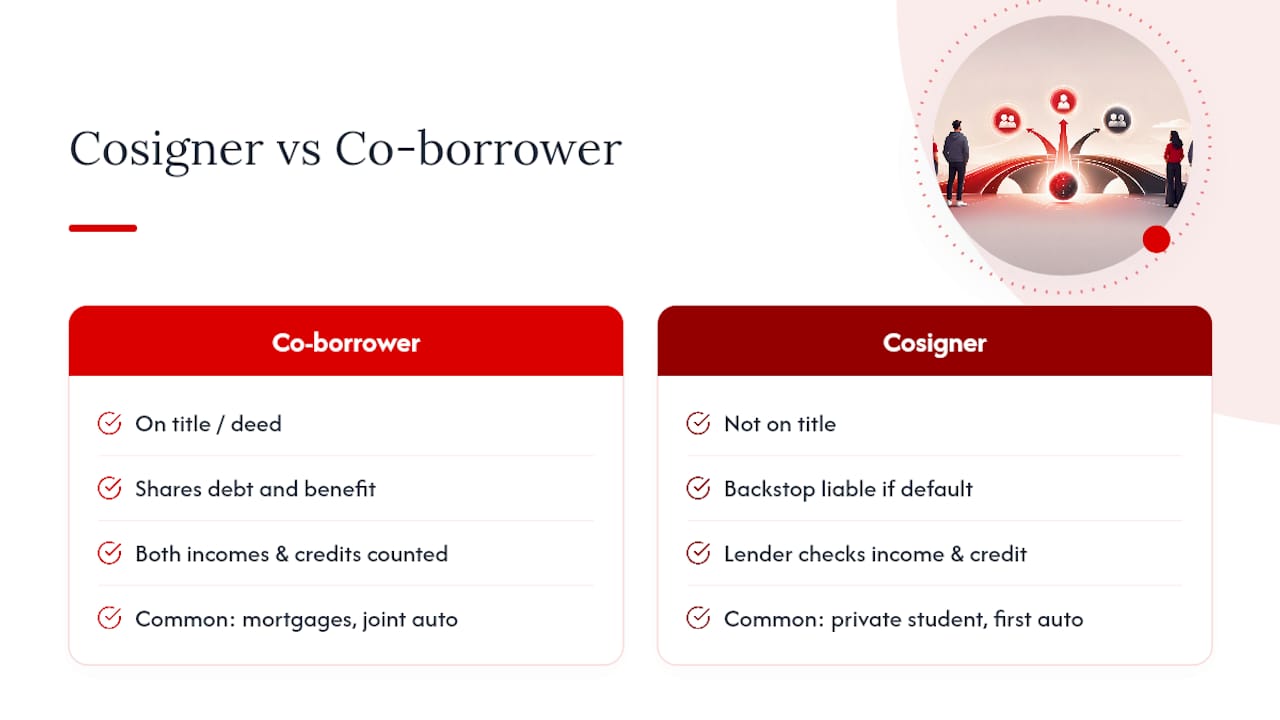
A co-borrower shares ownership of the loan and, usually, the asset. A cosigner guarantees repayment but typically holds no ownership stake at all. Both names go on the loan and both credit reports take the hit if a payment is missed, but only one role gives you a claim on the car, house, or property tied to it. That distinction shapes everything from mortgages, auto loans, and private student debt.
TL;DR:
- A co-borrower shares ownership and both credit profiles, while a cosigner only guarantees repayment without ownership rights.
- Both parties are fully liable if payments are missed, but a co-borrower also has a claim on the asset, unlike a cosigner.
- Cosigners improve approval chances but face full repayment liability and credit impact if the primary borrower defaults.
- Removing a cosigner typically requires refinancing, payoff, or lender approval due to the binding legal obligation.
- Always ask about and get written confirmation of a release clause before cosigning or co-borrowing, especially for auto and student loans.
Table of Contents
- Cosigner Vs Co-Borrower: What Sets Them Apart
- Co-Borrower Pros and Cons
- What Is a Cosigner and When Do Lenders Ask for One?
- Cosigner Pros and Cons
- How Credit Reporting, Collections, and Removal Actually Work
- Choosing a Cosigner vs a Co-Borrower: Questions to Ask First
- Elmwood Auto Sales' Checklist for Auto Loan Cosigners and Co-Borrowers
- Why Getting It in Writing Protects Everyone
- Financing Help Without the Pressure Tactics
- Sources
- FAQ
Cosigner Vs Co-Borrower: What Sets Them Apart
A co-borrower applies for the loan jointly, is listed on the title or deed, and shares both the debt and the benefit of whatever the loan pays for. Think of a married couple buying a house together, or two friends splitting the cost of a truck. The lender counts both incomes and both credit profiles during underwriting, which often lowers the debt-to-income ratio enough to unlock a better interest rate or a larger approved amount.
A cosigner is different. The lender still checks their income and credit, and their name still appears on the promissory note, but a cosigner is not on the title. They exist as a backstop, someone the lender can chase if the primary borrower stops paying. That's why cosigners show up most often with mortgages and joint auto loans, where two people intend to own and use the asset together, while cosigners tend to appear on private student loans, first-time auto loans, and other cases where one borrower's credit alone isn't strong enough.
Selling the asset or refinancing later gets more complicated with a co-borrower, since both names need to agree and both signatures are usually required to release either one from the loan.
Co-Borrower Pros and Cons
Combining two incomes and two credit histories on one application tends to improve approval odds and can push the loan into a better rate tier. You also split the monthly payment and build equity together, which matters if you're buying a home or a vehicle you both plan to use.
The trade-offs are real, though:
- Both parties are fully liable for the entire balance, not just half, if the other stops paying.
- Major decisions, like selling or refinancing, require both signatures and mutual agreement.
- A falling-out between co-borrowers can get legally messy fast, especially with property involved.
- Check local rules on title, estate transfer, and tax treatment before signing, since these vary by state and by asset type.
What Is a Cosigner and When Do Lenders Ask for One?
A cosigner is a guarantor. They promise to repay the loan if the primary borrower can't, but they generally receive no ownership rights and no use of the asset. Lenders ask for a cosigner when the primary applicant has thin credit, a short credit history, or income that doesn't quite clear the approval bar on its own. This shows up constantly with private student loans, first cars for young drivers, and occasionally personal loans for borrowers rebuilding credit.
Cosigned debt appears on the cosigner's credit report exactly like their own loan would, and it counts fully against their debt-to-income ratio when they go apply for anything else, a mortgage, a car loan, even a credit line increase. The Federal Trade Commission requires lenders to give every cosigner a formal "Notice to Cosigner" before signing, spelling out that cosigning creates a binding legal obligation to repay the full amount if the primary borrower defaults. Read that notice closely. It exists because so many cosigners assume their role is symbolic.
Cosigner Pros and Cons
For the primary borrower, a cosigner can be the difference between an approval and a denial, and sometimes it shaves real percentage points off the interest rate. For the cosigner, the appeal is usually personal: helping a family member or partner get on their feet, without wanting or needing ownership of what's being financed.
But the risks sit almost entirely on the cosigner's side:
- Full repayment liability if the borrower misses payments, not a proportional share.
- The debt counts against the cosigner's own borrowing power for years.
- Missed payments and collections activity hit the cosigner's credit report just as hard as the borrower's.
- Getting removed from the loan later is often difficult and depends entirely on the lender's willingness to release them.
How Credit Reporting, Collections, and Removal Actually Work
Late payments and defaults report to both parties' credit files, whether the second name belongs to a co-borrower or a cosigner. There's no protective distinction here. A 30-day late payment dings both credit scores equally, and a default or repossession can knock both scores down for years.
Lenders can pursue a cosigner directly for the full balance, and in many states, they aren't required to exhaust collection efforts against the primary borrower first. Bankrate's guidance on cosigner rights confirms that lenders can go straight after whichever party is easiest to collect from, which sometimes means the cosigner gets the phone calls even when the primary borrower is only a few weeks behind.
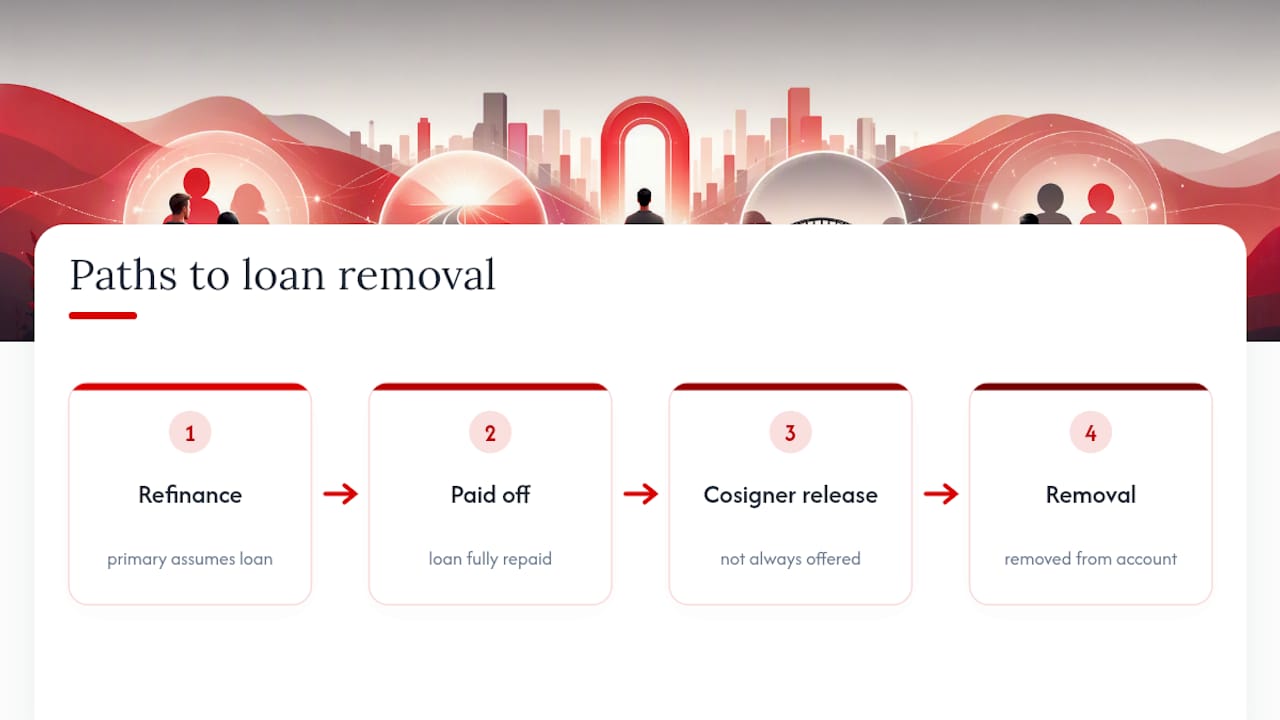
Getting released from a cosigned or co-borrowed loan usually comes down to three options: the primary borrower refinances into a new loan solely in their name, the loan gets paid off entirely, or the lender agrees to an explicit cosigner release, something not every loan offers. CFPB guidance on student loan cosigners notes that cosigned educational debt can sit on someone's credit file for a decade or more if a release clause was never part of the original agreement. Ask about it before you sign, not after.
Choosing a Cosigner vs a Co-Borrower: Questions to Ask First
Start with ownership. If you want a legal claim to the car, house, or asset, you need co-borrower status, not a cosigner arrangement. If you're just trying to help someone qualify and have no interest in owning what they're buying, cosigning may fit, provided you understand the liability you're accepting.
Before signing anything, ask these questions directly:
- Will my name appear on the title or deed, or only on the loan documents?
- Does this loan include a cosigner release option, and what triggers it?
- How will this loan affect my credit utilization and debt-to-income ratio going forward?
- What happens to my liability if the other party misses a payment or the relationship ends?
- Has the lender provided a written notice explaining my exact obligations?
Walk away if a lender can't answer the release question clearly, or if there's no written notice to cosigner at all. Vague answers here are a warning sign, not a technicality.
Elmwood Auto Sales' Checklist for Auto Loan Cosigners and Co-Borrowers
Auto financing has its own wrinkles worth checking before you commit. Confirm who's listed as title holder, what the payment schedule looks like, whether prepayment penalties apply, and what happens in a repossession scenario, since these terms vary more than buyers expect. Set up payment alerts on the account, and always get a written repayment agreement between co-borrowers so nobody's relying on memory six months in.
Buy-here-pay-here and other in-house financing models can shift the risk picture, since title arrangements sometimes differ from traditional dealer-lender loans and repossession can move faster.
Pro Tip: Before you sign as a cosigner on any vehicle loan, ask specifically about a release clause or map out a realistic refinance timeline. Don't assume you'll be removed automatically once payments run smoothly for a year or two.
Why Getting It in Writing Protects Everyone
Money and relationships mix badly when expectations aren't written down. Whether you're cosigning for a sibling or co-borrowing with a partner, a simple written repayment agreement and regular payment updates prevent the misunderstandings that quietly wreck both credit scores and friendships.
— Elmwood
Financing Help Without the Pressure Tactics
Some dealerships work through cosigner and co-borrower arrangements regularly, and structure paperwork so both parties know exactly what they're signing before they sign it. Vehicles typically go through a thorough inspection first, and financing teams often offer tailored in-house and third-party options for a range of credit histories, including buyers who need a cosigner to qualify.

Some dealerships do not use commission-based sales tactics, which can reduce pressure to rush decisions involving someone else's credit. If you're weighing whether to bring a cosigner or a co-borrower onto your next auto loan, schedule a test drive and meet with our financing staff to walk through the paperwork and your options in person.
Sources
Claims here draw on the FTC's cosigner guidance, CFPB's student loan cosigner explainer, Rocket Mortgage's co-borrower comparison, Bankrate's cosigner rights breakdown, and SoFi's cosigner responsibility overview. Verify any lender's licensing through NMLS Consumer Access before signing.
This article is general information, not a substitute for advice from a qualified financial advisor. Consult a qualified financial professional about your own circumstances before acting on anything here.
- Cosigning a Loan FAQs | Consumer Advice (FTC)
- Co-borrower vs. co-signer | Rocket Mortgage
- Cosigner rights and responsibilities: How it works | Bankrate
- What Is the Responsibility of a Cosigner on a Loan? | SoFi
FAQ
Is it better to have a cosigner or a co-borrower?
It depends on intent: choose a co-borrower if both parties want ownership and shared use of the asset, and a cosigner if one person just needs help qualifying without claiming ownership.
Is my spouse considered a co-borrower on my mortgage?
Only if their name appears on both the loan and the title; being married doesn't automatically make a spouse a co-borrower unless they're formally listed on the mortgage documents.
Does being a cosigner make you an owner?
No, cosigning typically grants no ownership rights at all, even though the cosigner carries full legal responsibility for repayment if the borrower defaults.
Is there a downside to having a cosigner?
Yes, for the cosigner especially: the debt counts fully against their credit and debt-to-income ratio, and removing them later usually requires refinancing, payoff, or a lender-approved release.
Can a cosigner get removed from an auto loan?
Sometimes, but it depends on the lender; refinancing into the primary borrower's name alone or paying off the loan are the most reliable paths, and dealerships or financing staff can help explain what a specific lender allows.