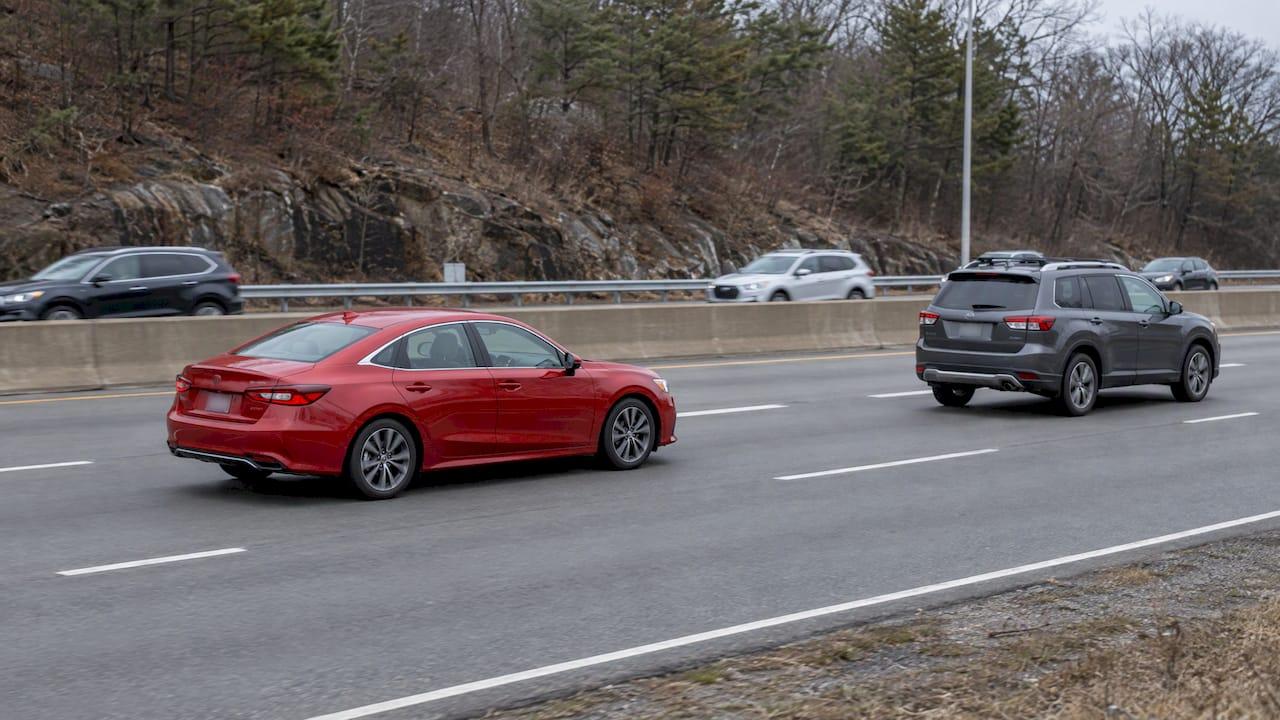
Adaptive cruise control (ACC) is cruise control that watches the car ahead. You set a speed and a following gap, and the car slows down, and in many models speeds back up, to hold that gap. It reduces pedal work on highways, but you still do the driving. This guide covers how it works, how it differs from regular cruise control, how to use it safely, and what to check when a used car is advertised with it.
TL;DR
- ACC keeps a driver-selected gap to the vehicle ahead by braking and accelerating, using radar, cameras, lasers, or a mix of them.
- Regular cruise control holds one speed and does not react to traffic.
- ACC has limits: stopped vehicles, bad weather, poor lighting, and winding or hilly roads can all reduce performance. You stay responsible at all times.
- On a used car, look for the steering-wheel controls, confirm the feature on the window sticker or build sheet, and check how it behaves on a test drive.
- Ask a dealer which specific vehicles have ACC instead of assuming a trim level includes it.
Table of Contents
- What is adaptive cruise control?
- How does adaptive cruise control work?
- How is adaptive cruise control different from regular cruise control?
- When should you use adaptive cruise control, and when should you not?
- What are the limits of adaptive cruise control?
- Does adaptive cruise control save money or improve safety?
- How do you check adaptive cruise control on a used car?
- Which used vehicles are worth looking at?
- How can Elmwood help you find a car with the features you want?
- FAQ
- Sources
What is adaptive cruise control?
Adaptive cruise control is an upgrade to the cruise control most drivers already know. Standard cruise control holds the speed you set. ACC does that too, but it also measures the distance to the vehicle in front. When that vehicle slows, your car brakes to keep the gap. When traffic clears, it accelerates to return to your set speed, according to Consumer Reports' guide to adaptive cruise control.

The same guide notes that systems use lasers, radar, cameras, or a combination of these to detect the car ahead. You may see it called by different names depending on the brand, such as dynamic radar cruise, intelligent cruise, or smart cruise. The function is the same: speed control that responds to traffic.
ACC is a driver assistance feature, not self-driving. It manages speed and following distance. You keep your eyes on the road, your hands on the wheel, and your foot ready for the brake.
How does adaptive cruise control work?
Three parts do the work: a sensor, a computer, and the car's brakes and throttle.
- The sensor is usually a radar unit behind the front grille or bumper, sometimes paired with a camera near the rearview mirror. It measures how far away the vehicle ahead is and how fast the gap is changing.
- The computer compares that gap with the following distance you chose. If the gap is shrinking too fast, it asks for less throttle or applies the brakes.
- The brakes and throttle carry out the request. When the road ahead opens up, the system lets the car return to the speed you set.
Most drivers choose between several gap settings, often shown as bars or car icons on the dash. A shorter gap is closer to the car ahead, and a longer gap gives more room. In dense highway traffic, a longer setting usually feels more relaxed because the car makes smaller, smoother adjustments.
Does it work in stop-and-go traffic?
It depends on the system. According to Consumer Reports, most ACC systems can bring a vehicle to a stop and resume when traffic moves again. Others work only within certain speed ranges, or may not accelerate automatically after slowing. This is one of the biggest differences between models, and it matters for commuters who sit in traffic on Route 95 or Route 146.
Do the brake lights come on?
Brake lights are generally tied to the car applying its brakes, so when ACC uses the brakes to slow you down, the lights behind you should come on. Gentle slowing that comes only from easing off the throttle may not trigger them. Details vary by manufacturer, so check the owner's manual for the exact car you are considering. We have not found an official source that states a rule for every model.
How is adaptive cruise control different from regular cruise control?
The core difference is awareness of traffic. Conventional cruise control does not automatically keep a set distance from the car in front. Adaptive cruise control assists with acceleration and braking to maintain a gap you select, as Consumer Reports explains.
| Feature | Regular cruise control | Adaptive cruise control |
|---|---|---|
| Holds a set speed | Yes | Yes |
| Reacts to the car ahead | No | Yes |
| Brakes automatically | No | Yes, within the system's limits |
| Resumes speed after traffic clears | You do it manually | Often automatic |
| Sensors needed | Speed input only | Radar, camera, laser, or a combination |
| Driver still responsible | Yes | Yes |
In practice, regular cruise control suits open, light-traffic roads. ACC is more useful where traffic speeds change, such as commuter highways and long trips with a mix of lanes and trucks.
When should you use adaptive cruise control, and when should you not?
The makers and safety agencies agree on one thing: keep full attention on driving and be ready to steer and brake at any moment.
Chevrolet advises against using ACC on winding or hilly roads and on freeway entrance and exit ramps, and notes that bad weather or blocked sensors can affect performance, per its driver assistance guidance. Transport Canada goes further and says ACC should only be used on highways, not on urban roads. That is Canadian guidance, but it matches how most owners' manuals describe the best use of the feature.
A practical list for Rhode Island driving:
- Good fit: steady highway driving, such as long stretches of I-95 or I-295 in dry conditions.
- Use extra caution: rain, snow, glare, or dusk, when sensors and cameras have less to work with.
- Skip it: winding back roads, city streets, exit ramps, and anywhere traffic changes unpredictably.
- Keep clean: snow, ice, mud, or road salt on the front sensor area can block detection. Wipe it before you drive in winter.
Kelley Blue Book says conventional and adaptive cruise control are safe when used appropriately, and that the driver remains responsible for operating the car safely. That is the right way to think about it: ACC supports a driver who is already paying attention.
What are the limits of adaptive cruise control?
Knowing the limits is part of using the feature well. Chevrolet's guidance says ACC may not react to parked, stopped, or slow-moving vehicles, has limited braking power, and may perform less well in bad weather, poor lighting, or on winding or hilly roads. It does not replace driver attention.
Federal regulators have looked at the same issue. In a 2025 review, NHTSA's Office of Defects Investigation described limitations in one manufacturer's ACC in detecting stationary vehicles at highway speeds and in poor visibility. The takeaway for drivers is general: be ready to take over, especially at night or at higher speeds, where sensors may not detect something stopped in your lane.
A few habits make the system easier to live with:
- Pick a following gap that feels comfortable, not the shortest one.
- Keep your foot near the brake pedal in dense or changing traffic.
- Cancel the system when you leave the highway, before you reach the exit ramp.
- Read the owner's manual for the speed range of your specific car, since some systems only work above a minimum speed.
Does adaptive cruise control save money or improve safety?
Many drivers like ACC mainly for comfort. It takes small, repeated speed adjustments off your plate on long drives. Whether it improves fuel use or safety depends on the car, the road, and how you drive. We would not promise a specific savings number, and we have not seen a source that supports one for every vehicle.
What we can say is that it is widely available. Consumer Reports found that 92% of vehicle models offered adaptive cruise control in 2021, either as standard equipment or as an option. That is a good sign for used-car shoppers, because more late-model vehicles may have it. "Offered" does not mean "installed," though, which is why checking the actual vehicle matters.
How do you check adaptive cruise control on a used car?
This is where many buyers get stuck. Features that were optional or tied to a package when the car was new are not always obvious today. The Insurance Institute for Highway Safety found that used-car buyers were less likely than new-car buyers to know about the advanced driver assistance features in their vehicles, describe how they work, and trust them. IIHS research also suggests that explaining these systems early in the buying process can help close that gap.
Here is a simple routine.
Look at the steering wheel and dash
Consumer Reports suggests looking for an ACC button on the steering wheel that shows a car next to a speedometer, or a button that adjusts the gap distance. If the car has regular cruise control only, you will usually see on/off, set, resume, and cancel buttons with no gap control.
Confirm it in the vehicle's paperwork
Ask for the original window sticker, a build sheet, or the feature list for the exact VIN. Trim names can be misleading: one trim may have ACC standard and another may not. Consumer Reports has also recommended that window stickers, menus, controls, and displays use consistent terminology, which tells you that the names for these features can vary from one place in a car to another. If a listing says "smart cruise" or "radar cruise," ask what it does.
Check it on the road
On a test drive that includes a highway stretch, engage the system when the road is clear, then watch how it follows another vehicle. Note these things:
- Does it set and cancel without error messages?
- Does the dash show the vehicle ahead when it detects one?
- Does it slow smoothly, and can it stop and resume, or does it drop out below a certain speed?
- Do any warning lights or sensor messages appear?
The speed limits matter. As Consumer Reports notes, some systems work only within certain speed ranges. Compare what you see with what the owner's manual says.
Look at the sensor area
Check the front grille emblem area, the lower bumper, and the windshield near the mirror for damage, cracks, or signs of repair. A collision repair near the sensor can affect how the system works, so ask whether the vehicle has any history in that area and review the vehicle history report.

Read the agreement before you sign
Whatever features you are counting on, make sure the listing, the paperwork, and the contract all describe the same car. A short primer on legal car purchase agreements can help you know what to look for in the paperwork.
Which used vehicles are worth looking at?
Because ACC is common on newer models and less common on older ones, the model year of the car makes a real difference. Our inventory changes constantly, and it includes a range of sedans, SUVs, trucks, and vans at different ages. We do not want to guess which of them carry ACC, so ask us about a specific vehicle and we will go through its listed features with you.
If safety features are high on your list, our guide to the safest cars for daily driving is a good place to start, and our explainer on blind spot monitoring covers another driver assistance feature you may see on the same vehicles. First-time buyers may also want to read about certified used car benefits.
Our perspective on driver assistance features
At Elmwood Auto Sales, we think buyers deserve to understand a feature before they pay for it. ACC is a good example: it can make highway driving easier, but it only helps if you know what it does and where it stops.
That is why we run a low-pressure process. Our team does not work on commission-based sales tactics, so when you ask whether a car has adaptive cruise control, you get a straight answer instead of a pitch. We also stand behind thorough vehicle inspections, because a driver assistance feature is only worth having on a car that is sound and reliable first.
Our advice is to decide which features matter to you, ask to see them demonstrated, and take your time. If you are comparing a few vehicles, we are happy to go through the details side by side.
Elmwood
How can Elmwood help you find a car with the features you want?
If adaptive cruise control is on your must-have list, tell us. We can use our Car Finder service to look for a vehicle that fits your needs, or you can browse our used cars, trucks, SUVs, and vans in Providence.
We offer financing options for a range of credit profiles, including buy here, pay here solutions, and you can start with our online financing application. If you have a vehicle to trade, you can trade in or sell your car with us and put its value toward your next one.
FAQ
Is adaptive cruise control the same as self-driving?
No. ACC controls speed and following distance only. You steer, watch the road, and need to be ready to brake. Safety agencies and manufacturers describe it as a driver assistance feature that does not replace driver attention.
Can adaptive cruise control stop the car completely?
Some systems can, and some cannot. Consumer Reports says most ACC systems can bring a vehicle to a stop and resume when traffic moves, while others work only within certain speeds. The owner's manual for the specific car tells you which type it has.
Does adaptive cruise control work in rain or snow?
It can, but performance may drop. Chevrolet notes that bad weather, poor lighting, and blocked sensors can affect the system. In wet or wintry conditions, keep the sensor area clear, choose a longer following gap, and consider driving without it.
How can I tell if a used car has adaptive cruise control?
Look for a steering-wheel button with a car beside a speedometer symbol, or a button that changes the following gap. Then confirm the feature through the window sticker or build sheet for that VIN, and check how it behaves on a highway test drive.
Sources
- Guide to Adaptive Cruise Control, Consumer Reports
- How to Use Adaptive Cruise Control, Chevrolet Vehicle Support
- Adaptive cruise control, Transport Canada
- Cruise Control: How Does It Work?, Kelley Blue Book
- NHTSA Office of Defects Investigation resume, 2025
- Consumer Reports, Understanding Vehicle Automation, November 2021
- IIHS: Information on advanced features is less likely to reach used-car buyers
- IIHS: New and used vehicle buyers' awareness, understanding, and trust
- Consumer Reports, Active Driving Assistance Evaluation Report, October 2023