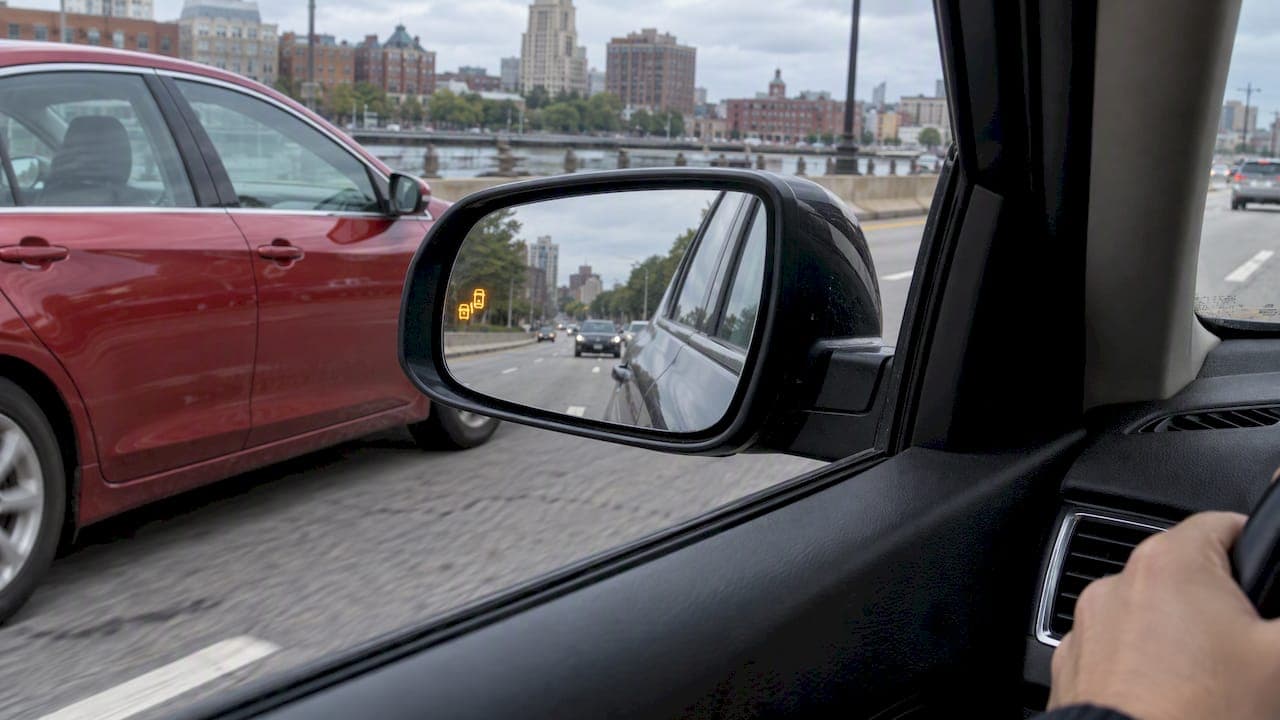
Blind spot monitoring is a driver-assist feature that uses radar or cameras to watch the lanes beside and behind your car. It warns you, usually with a light in the side mirror, when another vehicle is where your mirrors can't show it. It is a helpful second set of eyes. It does not replace a shoulder check.
This guide explains what the system does, how the alerts differ from car to car, where it falls short, and how to test it on a used vehicle. We also cover what a repair to a bumper or mirror can mean for the sensors.
TL;DR
- Blind spot monitoring detects vehicles in the lanes next to and behind you and warns you with a light, and sometimes a sound or vibration.
- IIHS-HLDI data links it to 14% fewer lane-change crashes.
- It can miss fast-approaching vehicles, motorcycles and bicycles, and it can be limited by weather, dirt and low speeds.
- Systems differ by make and model, so read the owner's manual and test the feature before you buy a used car.
- Sensors sit in bumpers and mirrors, so past bodywork matters on a used vehicle.
Table of Contents
- What is blind spot monitoring?
- How does blind spot monitoring work?
- Does blind spot monitoring work?
- Can you trust blind spot monitoring?
- Does it replace adjusting your mirrors?
- Why does blind spot monitoring matter when buying a used car?
- What we think about blind spot monitoring
- How can Elmwood help you find a car with the features you want?
- What else should you check beside safety tech?
- FAQ
- Sources
What is blind spot monitoring?
Every car has blind spots. These are areas to the side and rear that your mirrors and your own field of view don't cover. Your height, the seat position, the size of the vehicle and the way the mirrors are set all change where they are. Kelley Blue Book describes blind spot monitoring as a driver-aid and safety technology that alerts you to cars approaching in an adjacent lane from behind.
You may see it under other names. Manufacturers call it blind spot warning, blind spot detection, blind spot information system or a brand-specific name. The idea is the same in each: sensors watch a zone and the car tells you when it is occupied.
The system is built as an aid. The SAE J2802 recommended practice sets out the minimum operating characteristics and user interface for these systems, and it recommends a visual indicator. It is a good reference for why the light in your mirror behaves the way it does.
How does blind spot monitoring work?
The car needs two things: a way to sense nearby traffic and a way to tell you. Mazda explains that systems commonly use radar or camera sensors to monitor the adjacent lanes. The sensors are usually mounted in the rear bumper corners or in the side mirrors, where they can look back along the flanks of the car.
When a vehicle enters the monitored zone, the system turns on a warning. Here is the usual order of events:
- The sensors scan the lanes beside and behind your car while you drive.
- The software decides whether an object is a vehicle in your blind zone or approaching it.
- A light comes on, commonly in the side mirror, on the A-pillar or on the infotainment display.
- If you signal a lane change while the zone is occupied, many systems escalate the warning.
That last step matters. According to the same Mazda resource, many systems add audio or haptic alerts, such as a steering wheel or seat vibration, when the turn signal is on. Your signal tells the car you intend to move into that lane. Some more advanced systems can also step in with steering or braking to help prevent a collision.
What do the alerts look like?
The visual alert is the most common one. It is typically a small icon, often a car shape or a triangle, that lights up in or near the mirror glass. Because it sits where you look before changing lanes, it works as a quiet reminder in normal driving and as a louder one only when you commit to a move.
Chimes, beeps and vibration vary by manufacturer. Some cars let you adjust the alert volume or brightness in the settings menu. If a car you are considering seems to have no alerts at all, check that the feature has not been switched off.
Is it the same as rear cross-traffic alert?
No, though they often share the same rear sensors. Blind spot monitoring watches the lanes beside you while you drive. Rear cross-traffic alert watches for vehicles crossing behind you when you reverse, such as in a parking lot. NHTSA's performance report notes that drivers should consult the owner's manual to learn whether a system includes complementary features like this one. Don't assume that one comes with the other.

Does blind spot monitoring work?
Yes, in the real-world data we have. The IIHS and HLDI review of crash avoidance technology found these results for vehicles with blind spot detection compared with those without it:
| Measure | Difference |
|---|---|
| Lane-change crashes | 14% fewer |
| Lane-change crashes with injuries | 23% fewer |
| Claim rates for damage to other vehicles | 7% lower |
| Claim rates for injuries to people in other vehicles | 8% lower |
Those are meaningful gains, and they come from a system that is only a warning light in most cars. The gains also depend on drivers still doing their part. The system helps most when it backs up good habits, not when it replaces them.
Can you trust blind spot monitoring?
You can trust it as a backup, not as the final word. The SAE standard makes the point plainly: when no indicator is lit, that doesn't guarantee a lane change is safe, because a rapidly approaching vehicle outside the monitored zone may not be detected.
Here are the limits that matter in daily driving.
Speed and parking lots
Many systems have a minimum operating speed. According to the NHTSA report, thresholds typically fall between 5 and 20 mph. That means the system may be silent in stop-and-go traffic or while you maneuver in a lot.
Weather, mud and snow
Sensors sit on the outside of the car. They can be blocked by mud, snow or road debris, and heavy rain or snow can cause a signal to drop out. In a Rhode Island winter, with salt spray and slush, it is worth wiping the rear bumper corners and mirror housings clean before a drive. Many cars display a message when a sensor is blocked, so watch for it.
Small road users and odd shapes
Motorcycles and bicycles can be harder for a system to pick up. Unusual exterior surfaces, such as open trailers, log trucks or custom body shapes, can also confuse the sensors and lead to missed detections or false alerts. Treat a quiet mirror light as "nothing detected," not as "nothing there."
Over-reliance
Automotive safety experts, as summarized by Mazda, point to a quieter risk. Drivers get used to the alerts and start scanning less on their own. If the system then gives a false alarm or fails to detect something, the driver is caught out. The fix is simple: keep checking your mirrors and glance over your shoulder every time.
Does it replace adjusting your mirrors?
No. Mirror setup still matters. Kelley Blue Book notes a method documented by George Platzer of SAE that sets the side mirrors further outward, so they just barely catch the edge of your own car. Done properly, it can nearly eliminate the blind spots. Many drivers find it takes real adjustment and practice, so try it in a quiet place and give it a few days.
The two approaches work well together. Good mirror position shrinks the blind zone, and the monitor covers what is left.
Why does blind spot monitoring matter when buying a used car?
If you shop for a used car, you will find that the feature is not universal. NHTSA's report stresses that performance depends heavily on the vehicle's design and sensor placement. Two cars with a mirror light can behave differently on the road.
It also appears on some trims and not others. A model may offer it as standard on one trim and as part of an option package on another, or not at all in an earlier model year. So don't assume a listing has it because the same model name had it elsewhere. Look at the specific vehicle.
How to check it on a specific car
Here is a practical routine for a test drive:
- Look for the warning icon in or near both side mirrors. Check the dashboard or infotainment screen for a settings option for blind spot or side alerts.
- Confirm that the feature is switched on in the settings menu.
- Drive on a multi-lane road above the minimum speed. Have a passenger tell you when a car is alongside, and see whether the light agrees.
- Turn on your signal while another car is in the zone and listen or feel for a stronger alert, if the car has one.
- Check the dashboard for any sensor or system warning messages when you start the car.
- Read the owner's manual section on the system to learn its speed range and limitations.
If you can, compare the left and right sides. A system that works on one side only deserves a question to the seller.
What if the car has had bumper or mirror work?
Safety features cut crash rates, but they can raise repair bills after a collision. The IIHS-HLDI report notes that because the sensors are embedded in bumpers or side mirrors, even minor bodywork in those areas can mean recalibration or replacement of the whole sensor assembly. On a used car, that makes the history of the bumper corners and mirrors worth asking about. A system that has been repaired should be tested as carefully as one that hasn't.
Ask for the vehicle history report and ask the seller directly whether the sensors have ever been recalibrated or replaced. Also look for mismatched paint or uneven panel gaps near the rear bumper corners.
What we think about blind spot monitoring
We sell used cars in Providence, and shoppers ask us about safety features more than they used to. Our view is straightforward.
We like blind spot monitoring. The crash data supports it, and it is especially helpful in the places where many of our customers drive: on I-95 and Route 146, in merging traffic, and on crowded city streets where cars and bikes appear quickly. For a family moving into a larger SUV with bigger blind zones, it can be a real comfort.

We also think it should never be the only reason to choose a car. A feature on a window sticker is only as good as the sensor behind it. That is why our approach to inspection matters to us. Every vehicle we sell goes through a thorough inspection, and we encourage you to test the features that matter to you, including this one, on your own drive. Our sales team doesn't work on commission, so you can ask a plain question and get a plain answer: does it work, and has anything been repaired?
If blind spot monitoring is high on your list, tell us. We can take it into account when we help you look at inventory, and we will say so honestly if a car you like doesn't have it. For more on choosing safer vehicles, see our guide to the safest cars for daily driving and our safest used cars archive.
— Elmwood
How can Elmwood help you find a car with the features you want?
If you want blind spot monitoring on your next vehicle, our Car Finder is a good place to begin: tell us what you are looking for and we will help you search. You can also browse our used cars, trucks, SUVs and vans and come in to test drive.
We offer tailored financing for a range of credit profiles, including buy here, pay here options, and you can apply for used car financing online. If you have a car to swap, you can trade in or sell your car with us. We don't publish prices for financing or appraisals, so ask us for the details that fit your situation.
What else should you check beside safety tech?
A working warning light is one item on a longer list. Before you buy any used car, also check the mileage. Our guide to NHTSA's two steps to expose odometer rollback shows how to do it. Then look at tires, brakes, fluid condition and the vehicle history report.
If you are buying for a family, think about the size of the vehicle and its visibility. Larger SUVs and trucks tend to have bigger blind zones, so the feature can be more valuable there, and a midsize SUV like this used Honda Pilot is the kind of vehicle where you should test your sight lines and any driver aids on the road. If you are after a commuter car instead, our everyday commuter cars archive is a useful place to start.
FAQ
What is a blind spot monitor?
It is a sensor-based safety system that detects vehicles in the lanes next to and behind your car. It then warns you, usually with a light in the side mirror. Some systems also add a sound or a vibration when you signal a lane change.
Does blind spot monitoring work in all conditions?
Not in all of them. Heavy rain, snow, mud and debris can block or confuse the sensors, and many systems stop working below a minimum speed, typically between 5 and 20 mph according to NHTSA. Keep the sensor areas clean and keep checking your mirrors.
Can I add blind spot monitoring to a car that doesn't have it?
We can't speak to aftermarket kits, and results vary. A simpler and more dependable route is to choose a vehicle that already has the feature from the factory and test it before you buy. Our Car Finder can help you search with that in mind.
Can I turn blind spot monitoring off?
In many cars you can, through the vehicle settings menu. The steps and options differ by make and model, so the owner's manual is the right place to look. If you are test driving a used car, confirm the feature is switched on before you judge it.
Sources
- Kelley Blue Book: Blind-Spot Monitors, Everything You Need to Know
- NHTSA: Blind Spot Monitoring in Light Vehicles, System Performance
- IIHS-HLDI: Real-world benefits of crash avoidance technology
- SAE J2802: Blind Spot Monitoring System operating characteristics and user interface
- Mazda USA: What Is a Blind Spot Monitor in a Car?