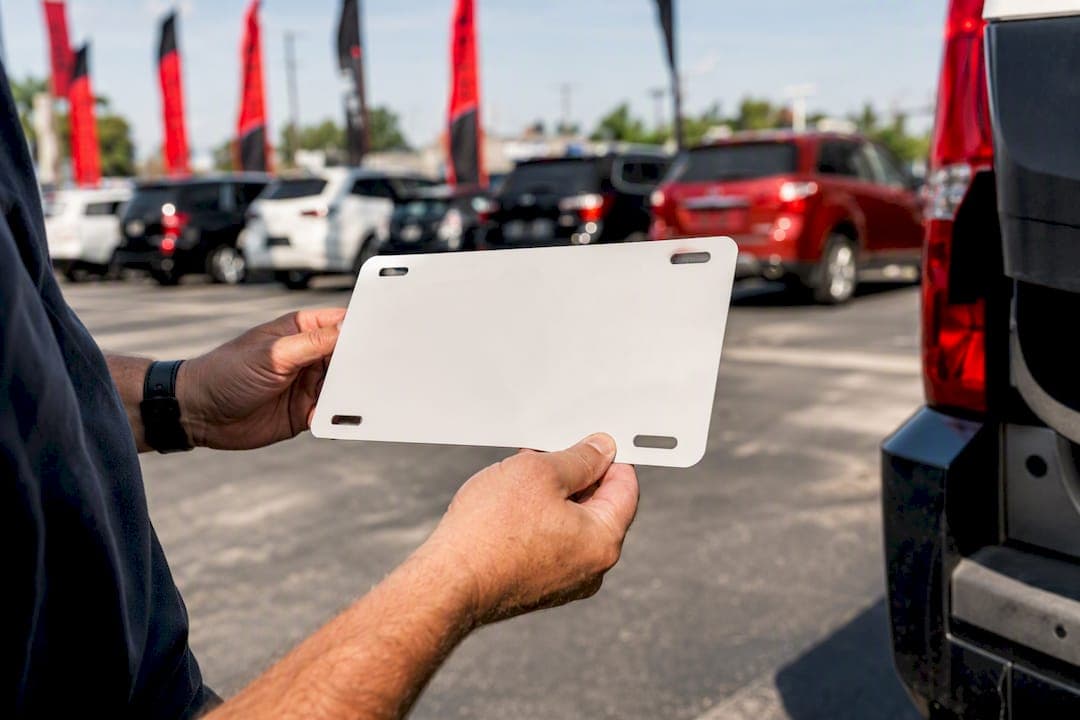
If you just bought a car in Rhode Island, you can drive it home legally with a temporary plate. Rhode Island residents get 5-day temporary plates at any DMV branch for private-party or out-of-state title transfers, mainly to reach a VIN verification appointment. Licensed RI dealers issue 20-day temporary plates through the state's online dealer portal for most dealer sales.
- Private-party or out-of-state transfer: 5-day plate, issued at a DMV branch
- Licensed dealer sale: 20-day plate, issued through the dealer portal
- Next step: visit any DMV branch with your paperwork, or ask your dealer to confirm they'll issue the plate before pickup
Key Takeaways
Rhode Island residents get a 5-day temporary plate for private-party transfers and a 20-day plate for dealer sales, both tied to strict document and timing requirements.
| Point | Details |
|---|---|
| Confirm your plate type | Private-party and out-of-state transfers get 5-day plates; dealer sales typically get 20-day plates. |
| Gather documents early | Bring signed title, bill of sale, proof of RI insurance, and ID or residency proof to any DMV branch. |
| Know the fee baseline | The statutory fee is $10.00 per plate under § 31-3-17.3, though branch guidance sometimes references $11.50. |
| Schedule your VIN check immediately | A 5-day window disappears fast if the VIN verification appointment gets delayed. |
| Work with a dealer for smoother processing | Elmwoodautosalesri confirms insurance, prepares titles, and coordinates VIN checks before pickup. |
Table of Contents
- Who Qualifies for a Rhode Island Temporary Plate?
- How Do Dealer-Issued Temporary Plates Work?
- What's the Process for Private-Party and Out-of-State Transfers?
- What Documents and Fees Should You Expect?
- How Do You Actually Get a Temporary Plate?
- Can You Drive Out of State on a Temporary Plate?
- What Elmwood Auto Sales Does Differently at Sale Time
- Why the Standard Advice on Temp Plates Misses the Point
- Let Elmwood Handle the Paperwork for You
- Where to Verify Forms, Fees, and Portal Access
- Sources
Who Qualifies for a Rhode Island Temporary Plate?
Temporary plates go to Rhode Island residents only. The DMV's temporary plates page requires proof of RI residency, typically a driver's license or state ID showing a Rhode Island address. Out-of-state buyers moving to Rhode Island need proof of their new residency before the DMV will process a temp plate request.
Vehicle age matters too. Some temporary plate categories carry a 2001-or-newer model year restriction, so older vehicles may need a different path through registration. Salvage vehicles, special mobile equipment, and horse trailers fall under separate rules in state regulation 280-RICR-30-10-7.3, which lists specific, narrow reasons the DMV allows temporary plates beyond a standard sale.
- Rhode Island residency required, proven by ID or documentation
- 2001+ model year applies to certain temp plate categories
- Salvage, special equipment, and horse trailers follow separate regulatory provisions
- If your vehicle already carries an RI plate, a transfer may replace the need for a temp plate entirely
How Do Dealer-Issued Temporary Plates Work?
Licensed Rhode Island dealers don't hand out paper plates from a drawer anymore. They generate them through the state's dealer temp-plate portal, an online system tied directly to DMV records. This keeps plate numbers traceable and cuts down on the fraud that paper-based systems used to invite.
Here's what typically happens at a dealer sale:
- The dealer confirms your insurance is active and pulls your ID and bill of sale
- The dealer logs into the RI.gov portal and creates a temporary plate tied to the vehicle
- You receive the plate, generally valid for 20 days, along with your paperwork
- You complete full registration at a DMV branch before the 20 days expire
Dealer processing sometimes carries its own line-item fee on the bill of sale, separate from the state's plate charge, so ask what's included before you sign.
Pro Tip: Always confirm the exact expiration date printed on your dealer plate and keep the dealer's paperwork inside the glove compartment. If you're stopped, that paperwork is what proves the plate is legitimate.
What's the Process for Private-Party and Out-of-State Transfers?
Buying from a private seller, or bringing a car in from another state, triggers the 5-day temporary plate process instead of a dealer plate. This plate exists mainly to get you and the vehicle to a VIN verification appointment, not for extended driving.
- Visit any DMV branch with your signed title, bill of sale, proof of RI insurance, and ID or proof of RI residency
- Complete the TR-1 registration application at the counter
- Receive your 5-day temporary plate
- Schedule and complete a VIN check, often at a local police department or DMV inspection station
- Return to finish full registration once the VIN verification clears
If paperwork is missing or the VIN check needs rescheduling, tell the clerk immediately. Some branches allow a short extension window, but you shouldn't assume one exists without asking.
What Documents and Fees Should You Expect?
Bring these four items every time you apply for a temporary plate:
- Signed vehicle title
- Bill of sale
- Proof of Rhode Island auto insurance
- RI license, ID, or proof of residency, plus a completed TR-1 form
The statutory fee is $10.00 per temporary plate, set directly in Rhode Island General Laws § 31-3-17.3. Some DMV FAQ and branch-level guidance references a $11.50 charge in certain contexts, which likely reflects processing differences between branches rather than a change to the statute itself. If you're unsure which figure applies to your visit, call the branch directly or check the DMV fee schedule before you go. Missing a document doesn't mean you're out of luck. It just means your registration gets delayed until you can supply it, and a dealer can often help track down a replacement title or corrected bill of sale faster than doing it solo.
How Do You Actually Get a Temporary Plate?
The path splits depending on whether you're buying from a dealer or a private seller.
Dealer path:
- Confirm with your dealer that they'll issue the plate through the RI.gov portal before you arrive for pickup
- Provide your ID, proof of RI insurance, and signed bill of sale
- Ask about any dealer processing fee tied to the plate
- Drive off with your vehicle and a 20-day temporary plate attached
DMV branch path:
- Bring your documents to any DMV branch
- Pay the plate fee at the counter
- Receive your 5-day temporary plate
- Schedule your VIN check if one hasn't already been arranged
Counter visits typically take under an hour if your paperwork is complete, though VIN check scheduling can add a day or two depending on police department availability in your city. If the DMV website or dealer portal is down, call your local branch directly rather than waiting.
Pro Tip: If a clerk refuses to issue your temporary plate, ask specifically which document triggered the denial. Nine times out of ten it's a missing insurance card or an unsigned title, both fixable the same day.
Can You Drive Out of State on a Temporary Plate?
Rhode Island law sets the standard temporary plate period at 5 days, with 20-day exceptions for dealer sales and horse trailers under § 31-3-17.3. Driving out of state on an RI temp plate is generally allowed for transport purposes, but you should carry your bill of sale, insurance card, and VIN-check appointment details in case you're stopped.
- Confirm the destination state doesn't have additional restrictions on out-of-state temp plates
- Never let the plate lapse before completing registration; overstaying invites fines and potential impound
- Treat the plate as transport authorization, not a substitute for full registration
What Elmwood Auto Sales Does Differently at Sale Time
We confirm your insurance is active, inspect the vehicle, and collect your signed title and bill of sale before you ever touch the keys. If a VIN check is needed, we coordinate the appointment instead of leaving you to figure it out.

Common buyer mistakes we catch early: driving off without active insurance, signing a title incorrectly, or assuming out-of-state buyers qualify for the same plate process as residents. Catching these before pickup saves you a second trip to the DMV.
Why the Standard Advice on Temp Plates Misses the Point
Most guides treat temporary plates like a formality, a box to check between buying a car and driving it home. That framing undersells what the plate actually is: a narrow legal tool the DMV built specifically for VIN verification and safe transport, not a stand-in for real registration.
The gap shows up in the fee confusion. Readers see $10 in the statute and $11.50 referenced elsewhere and assume someone made an error. Neither figure is wrong. The statute sets the baseline; branch-level processing can vary, and that inconsistency is exactly why calling ahead beats guessing.
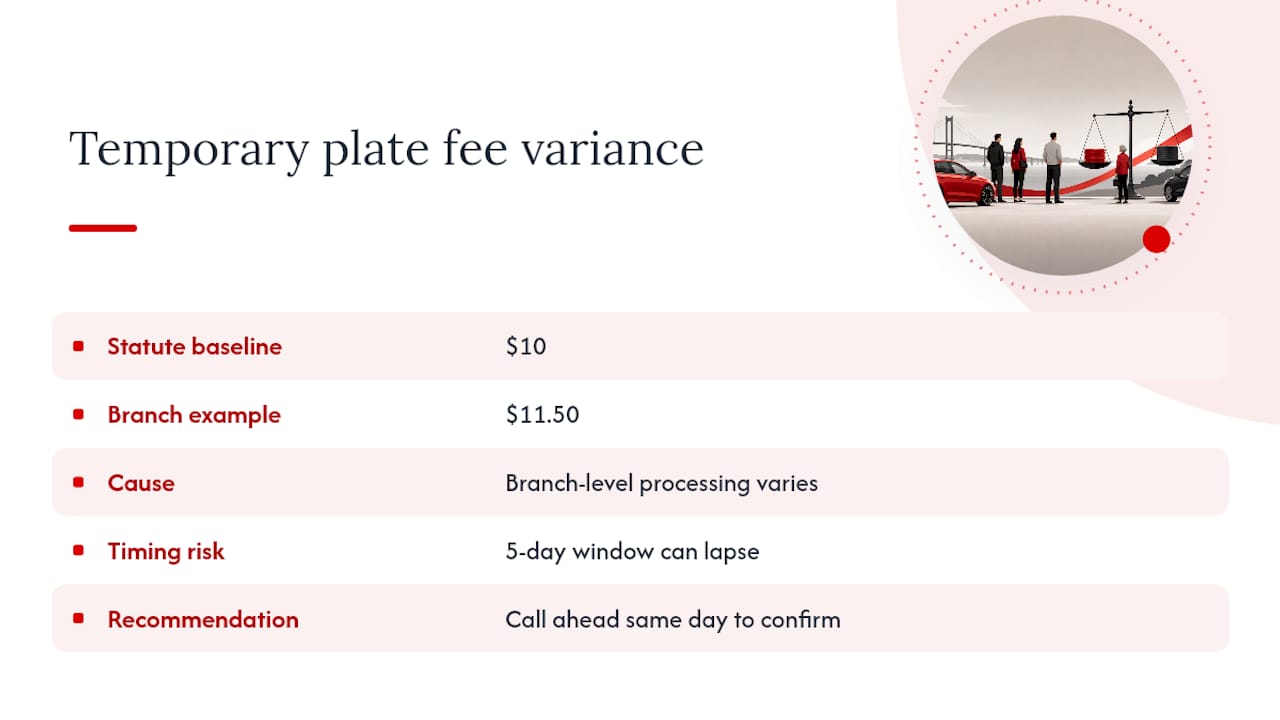
The bigger issue is timing. People fixate on the plate itself and ignore the clock attached to it. A 5-day window disappears fast if your VIN check gets scheduled a few days out. Prioritize locking in that appointment the same day you get the plate, not after.
Working with a dealer who handles the portal, the insurance confirmation, and the paperwork sequencing removes most of the risk. That's less about convenience and more about avoiding a lapsed plate and a registration you have to restart from scratch.
— Elmwood
Let Elmwood Handle the Paperwork for You
Buying a used car shouldn't mean you become your own DMV liaison. Elmwoodautosalesri confirms your insurance, prepares your signed title and bill of sale, and coordinates VIN check scheduling before you ever pick up the keys, so the temporary plate process becomes something we manage instead of something you chase down alone.
If you're ready to see what's available, search our used car inventory or book a test drive to start the process. Ask us to confirm your paperwork and plate timeline before pickup, and you'll walk out with a vehicle and a clear registration deadline instead of a stack of unanswered questions.
Where to Verify Forms, Fees, and Portal Access
- Download the TR-1 form and review eligibility on the DMV temporary plates page
- Check current fees and branch guidance through the DMV FAQ
- Licensed dealers register for plate issuance through the dealer temp-plate portal
Sources
- Temporary Plates | RI Division of Motor Vehicles
- Frequently Asked Questions | RI Division of Motor Vehicles
- 280 R.I. Code R. 280-RICR-30-10-7.3 - Issuance of Temporary Registration Plates