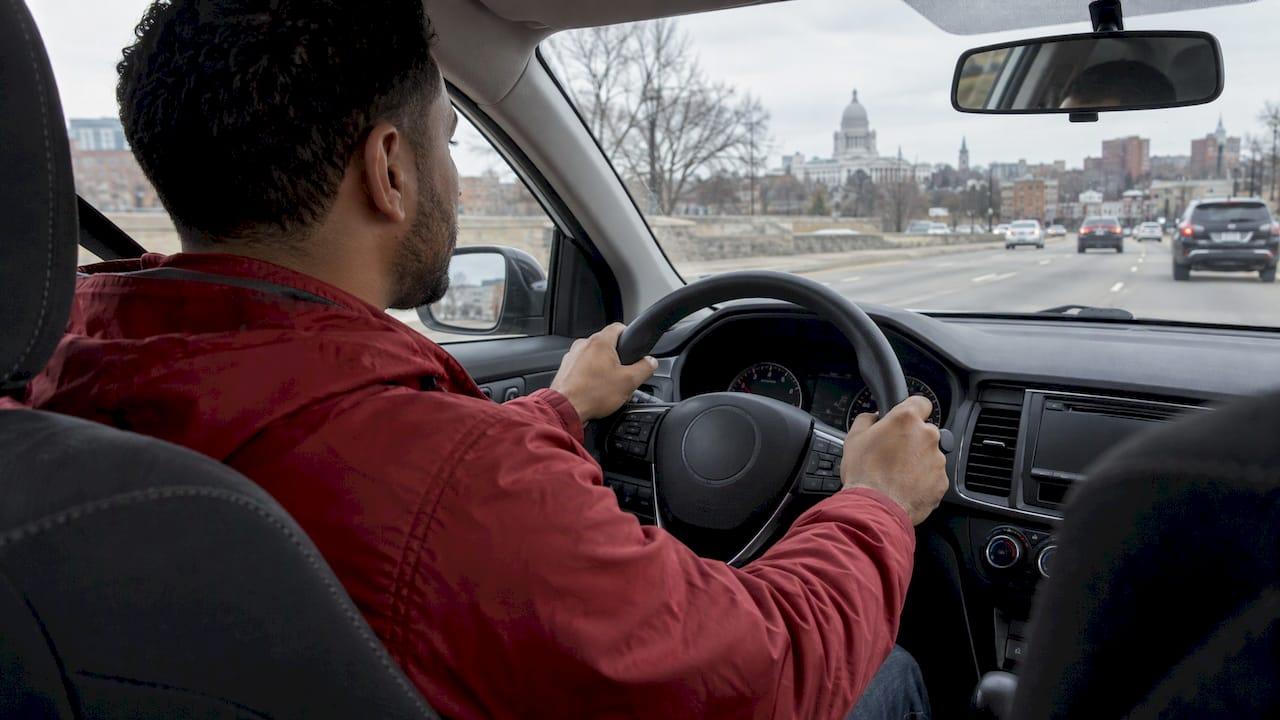
Lane departure warning (LDW) tells you that you are drifting out of your lane. Lane keep assist (LKA) goes one step further and nudges the steering to bring you back. According to NHTSA, LDW does not take any action to avoid a crash, while LKA uses the same sensor information to correct the vehicle's course. If you are shopping for a used car in Rhode Island, knowing which of the two a vehicle has helps you compare trims, ask better questions and drive the car the way it was designed to be driven.
At Elmwood Auto Sales in Providence, we want you to understand every feature on a vehicle before you sign anything. This guide explains both systems in plain terms, shows where each one can fail, and gives you a short checklist for your test drive.
TL;DR
- Lane departure warning (LDW) only alerts you, usually with a sound, a dashboard light or a vibration. You do the steering.
- Lane keep assist (LKA) adds a gentle steering correction when the car starts to leave its lane without a turn signal.
- Lane centering is a third, different feature: it steers continuously to keep the car in the middle of the lane.
- Both systems depend on a camera reading painted lane lines, so faded paint, snow and glare can stop them from working.
- Manufacturers use different names, so confirm what a specific used car has by checking its owner's manual and trying it on the road.
Table of Contents
- What does lane departure warning mean?
- What does lane keep assist do?
- How do the two systems compare side by side?
- Is lane keep assist the same as lane centering?
- Which one is better for you?
- What safety benefits do these systems offer?
- When can these systems fail to work?
- What should you check on a used car with lane assist?
- What other driver-assist features show up alongside lane assist?
- Where does Elmwood Auto Sales fit in?
- Our perspective
- FAQ
- Sources
What does lane departure warning mean?
Lane departure warning is a safety technology that watches the lane markings on the road and alerts you when the vehicle begins to drift across them. NHTSA describes it as a warning system: it monitors the markings and signals the driver when it detects the vehicle leaving its lane. The alert may be audio, visual or another form of warning.
The form of the warning depends on the car. Consumer Reports notes that LDW may warn you with a visual signal, a sound, or a tactile signal such as a vibration in the steering wheel or the seat. The system generally stays quiet when your turn signal is on, because a signaled lane change is a deliberate move, not a drift.
The key point is what LDW does not do. It does not steer, brake or accelerate. You hear or feel the alert, and then you have to react.
What does lane keep assist do?
Lane keep assist builds on the same camera and the same lane-marking information. When the system detects an unintended drift, it acts. NHTSA explains that LKA can correct the steering, brake or accelerate one or more wheels, or combine these actions to return the vehicle to its intended lane.
The Federal Highway Administration describes the same idea in simpler terms: LKA moves the vehicle back using steering torque or light differential braking, which means a small push on one side of the car.

In everyday driving, that feels like a light tug on the wheel as you cross a line. It is a nudge, not a takeover. You can still steer through it, and most systems let you adjust how sensitive it is or switch it off in the vehicle settings.
How do the two systems compare side by side?
Here is the short version for shoppers who are comparing window stickers or feature lists.
| Lane departure warning (LDW) | Lane keep assist (LKA) | |
|---|---|---|
| What it does | Alerts you to unintended drift | Alerts you and corrects the steering |
| How you feel it | Sound, light, or vibration | Light steering nudge or brief braking on one side |
| Who corrects the drift | You | The system first, then you |
| Turn signal on | Generally stays quiet | Generally does not intervene |
| Sensor | Forward-facing camera | Same camera and lane information |
The two are usually packaged together, and many cars offer LDW as a base layer with LKA on top of it. That is why a vehicle listing might say "lane departure warning" while the dashboard menu says "lane keep assist." The names overlap in everyday use, and some sources use "lane assist" for both.
Is lane keep assist the same as lane centering?
No, and this is where many shoppers get confused. Lane keep assist is reactive. It steps in when the car is about to cross a line. Lane centering assist is proactive: it applies steering all the time to keep the car near the middle of the lane.
Consumer Reports puts it this way: LKA provides steering support, while lane centering continually steers to center the vehicle. Its expert adds that LKA is not continuous steering and is meant to step in close to the moment of departure.
Neither is a self-driving feature. Consumer Reports is clear that none of these systems is designed to steer without driver input. Edmunds adds that after a period without steering input, the system may ask you to put your hands on the wheel and typically stops working if you do not respond.
Lane centering often comes bundled with adaptive cruise control. If that feature is on your list, our guide to how adaptive cruise control works explains the other half of that pairing.

Which one is better for you?
The honest answer is that they do different jobs, and the best choice depends on how you drive.
LDW suits drivers who want to stay in full control and simply want a prompt when attention slips. The FHWA reports that a warning only works if the driver notices it and responds correctly, so a distracted driver can miss an alert. LKA can reduce that dependence because it takes a corrective step on its own, and it can also help reduce the risk of overcorrecting, which is the sharp swerve some drivers make after an alert startles them.
Here is how that plays out for the shoppers we meet most often:
- First-time buyers benefit from the added layer. A system that corrects a slow drift can be a helpful backup while you build highway experience.
- Families doing long school-run and weekend drives in an SUV or truck often like having a steering nudge when a tired moment hits.
- Commuters on I-95 and Route 146 spend hours on roads with painted lane lines, where both systems have the clearest markings to work from.
Neither system replaces your attention. NHTSA states that drivers remain responsible for steering, braking and accelerating. Used as designed, the features support safe driving habits, which is where their value lies.
What safety benefits do these systems offer?
NHTSA says LDW can help prevent sideswipes, crashes with traffic in the opposite direction, and road-departure crashes. LKA adds a correction for unintended drift. These are the crash types that happen when a driver glances at a phone, reaches for something or simply gets tired.
The research on how drivers behave with these systems is nuanced, and it is worth knowing. In an FHWA simulator experiment, drivers in the warning-only condition tended to keep their lane better than drivers in the LKA or manual-control conditions. The takeaway for you is practical: whichever system your car has, treat it as a prompt to correct your own driving, not as something that drives for you.
There is a second benefit for buyers who like data. Safety ratings and driver-assistance features are part of how many shoppers compare vehicles. Our guide to the safest cars of 2026 covers IIHS and NHTSA ratings in more detail.
When can these systems fail to work?
Both systems depend on a forward-facing camera that reads painted lines. When the camera cannot see the lines, the features cannot do their job. Consumer Reports lists several situations that can confuse the camera: construction markings, faded or snow-covered lines, lines that disappear or merge, and direct sunlight that blinds the camera.
Edmunds makes the same point: systems generally need clear markings on both sides, faded paint, rain, snow or debris can hinder LDW, and LDW typically does not detect curbs or unmarked shoulders.
For Rhode Island drivers, that translates into a few realities:
- Winter. Snow and slush can cover lane lines for days after a storm, and road salt can build up on the windshield in front of the camera.
- Older pavement. Faded lines on secondary roads in and around Providence give the camera less to read.
- Work zones. Temporary or double markings can send mixed signals.
- Low sun. Sun glare at sunrise and sunset on a long straight road can briefly blind the camera.
When the system cannot see, it may stay off or show a warning light. That is normal behavior, and it is the moment to rely on your own driving.
What should you check on a used car with lane assist?
Manufacturers use different names for the same technologies, and some versions only warn while others take action. NHTSA recommends checking the owner's manual for the specific vehicle you are considering. Its Vehicle Shopper's Guide also encourages buyers to get familiar with the technologies on a vehicle they are shopping for or have recently purchased.
Here is a practical checklist for your test drive:
- Read the manual's driver-assistance section and note the exact name of the feature. "Lane departure alert," "lane keeping system" and "lane assist" can mean different things.
- Find the switch. Most cars have a steering-wheel or dashboard button, plus settings in the infotainment menu.
- Look at the dashboard on start-up. A lane-assist indicator that lights up and then goes out is a normal self-check.
- Check the settings menu for alert type (sound, light or vibration) and sensitivity.
- Drive on a road with clear lane lines and see what the alert feels like. Use your turn signal for lane changes, as the system expects.
- Ask which trim the car is. Driver-assistance features are often tied to a trim level or option package, so two cars of the same model and year can differ.
Our team is happy to walk you through the features on any vehicle in our lot. You can book a test drive and spend the time looking at these settings with the car in front of you.
What other driver-assist features show up alongside lane assist?
Lane assist rarely arrives alone. You will often see it listed next to blind spot monitoring and adaptive cruise control. Blind spot monitoring is a different job: it watches the zones beside and behind the car when you want to change lanes, while lane assist watches for unintended drift. Our explainer on blind spot monitoring shows how the two complement each other.
Families with a new teen driver often ask what else can add peace of mind. In-car alerts work inside the vehicle, and a teen driver tracker adds trip, arrival and speed alerts outside it. Together they give a young driver more support while they build experience.
Where does Elmwood Auto Sales fit in?
If lane departure warning or lane keep assist is on your must-have list, start with the vehicles in our used inventory, which includes cars, SUVs, trucks and vans. We offer a low-pressure buying experience without commission-based sales tactics, so you can take the time to look at the features you care about. Our vehicles go through thorough inspections.
If you want a specific vehicle, Car Finder is the place to start. If you need financing, our Used Car Financing page lets you apply online, and we offer tailored options for a range of credit histories, including buy here, pay here. If you have a vehicle to trade, you can trade in or sell your car with us and put its value toward your next one.
Our perspective
We think a driver-assistance feature is only worth having if you understand it. A lane departure warning that you do not recognize can feel like a random beep, and a lane keep assist nudge you did not expect can feel like the car is fighting you. Once you know that one alerts and the other corrects, both become useful.
That is why we do not sell by feature checklist. We have built our dealership around a low-pressure experience and honest conversations, with no commission-driven sales tactics, so you can sit in a car, find the settings and ask questions without being hurried.
Every vehicle we sell goes through a thorough inspection, because a safety feature is only as good as the car around it. We pair that with financing built for different credit situations, including buy here, pay here, so that a safer, more reliable used vehicle is within reach for first-time buyers, families and budget-conscious shoppers across Providence and the surrounding area.
Elmwood
FAQ
Is lane departure warning the same as lane keep assist?
No. Lane departure warning only alerts you when the car drifts out of its lane. Lane keep assist uses the same camera information but also applies a gentle steering correction to guide you back. Many cars include both, which is why the names are often mixed up.
Does lane keep assist drive the car for me?
No. It is an assistance feature, not hands-free driving. Consumer Reports says none of these systems is designed to steer without driver input, and Edmunds notes that the system typically stops working if you ignore its requests to take the wheel. You stay responsible for steering, braking and accelerating.
Is lane departure assist the same as blind spot monitoring?
No. Lane assist watches the painted lines to catch unintended drift out of your lane. Blind spot monitoring watches the areas beside and behind the car for other vehicles, mainly when you plan to change lanes. They work well together, and many used vehicles have both.
Can I turn lane keep assist off?
In most vehicles, yes. There is usually a button on the dash or steering wheel, or a setting in the infotainment menu, and many cars also let you change the alert style or sensitivity. Check the owner's manual for the exact steps, since the controls differ between manufacturers.
Was lane departure warning ever required on all cars?
NHTSA lists lane departure warning as a recommended safety technology and notes that manufacturers use different names for it. Because the feature is not universal, it is worth confirming that the specific used car you like actually has it.
Sources
- Driver Assistance Technologies, NHTSA
- Vehicle Shopper's Guide: Driver Assistance Technologies, NHTSA
- To Alert or Assist: Comparing Lane Departure Warning and Lane Keeping Assist, FHWA TechBrief
- Lane Departure Warning & Lane Keeping Assist, Consumer Reports
- How Does Lane Departure Warning Work?, Edmunds
- Teen Driver Tracker, Kin Watchdog