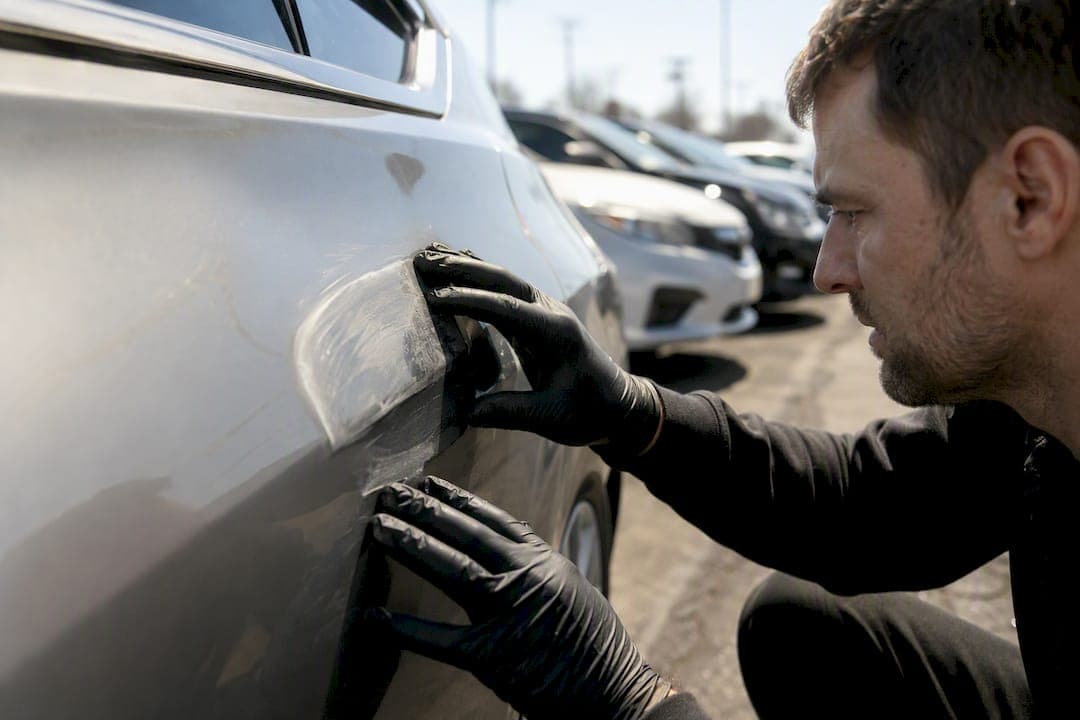
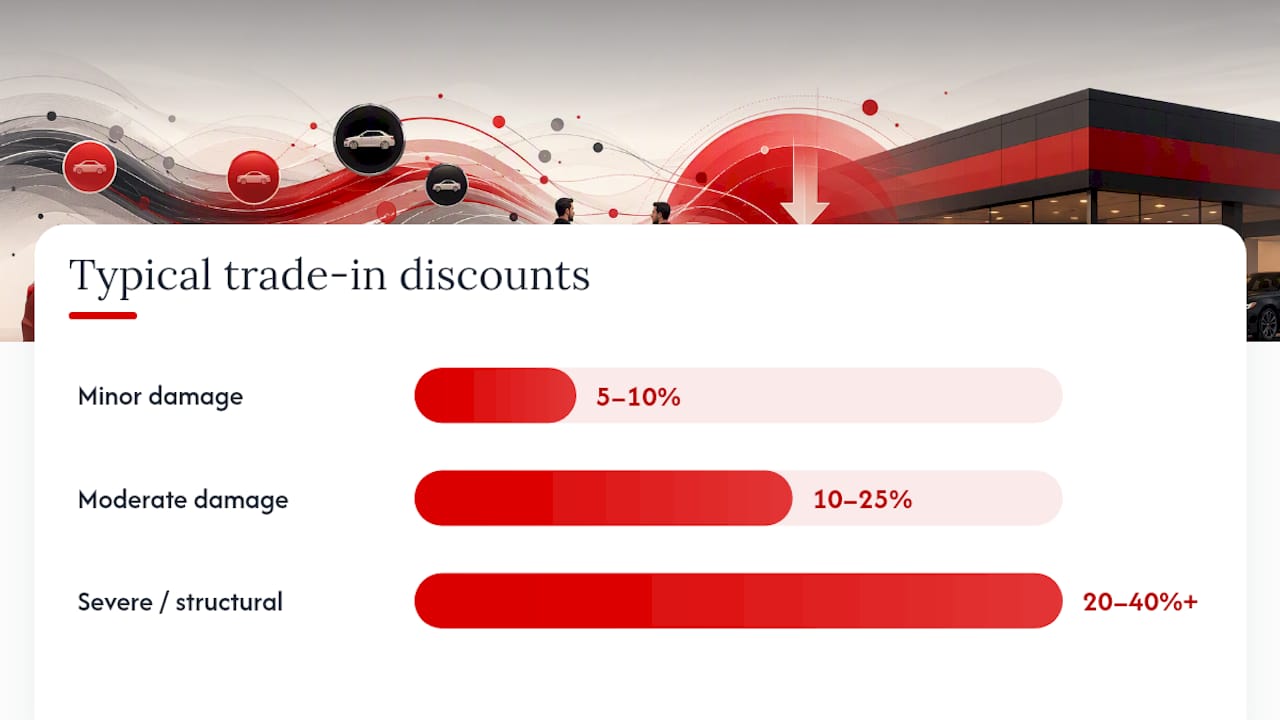
Yes, a recorded accident almost always lowers a car's trade-in and resale value, even after quality repairs. The typical loss falls into three bands: minor damage costs you roughly 5 to 10 percent, moderate damage runs 10 to 25 percent, and severe or structural damage can strip 20 to 40 percent or more off what you'd otherwise get. Vehicle-history reports from services like Carfax make the accident permanent on paper, and dealers price around that risk whether or not the repair looks perfect. Two things help right now: gather every repair invoice and OEM parts receipt you have, and book a pre-trade inspection before you accept any offer.
- Minor damage: expect a 5 to 10 percent hit
- Moderate damage: expect a 10 to 25 percent hit
- Severe or structural damage: expect a 20 to 40 percent or greater hit
- Collect repair documentation and get an independent inspection before negotiating
Key Takeaways
Accident history lowers trade-in and resale value in almost every case, but strong documentation and multiple offers can recover much of that lost equity.
| Point | Details |
|---|---|
| Expect a real discount | Minor damage costs roughly 5 to 10%, moderate 10 to 25%, severe or structural 20 to 40% or more. |
| History reports are permanent | Carfax and similar reports log severity wording that shapes both buyer perception and dealer pricing tools. |
| Dealers price for wholesale risk | Trade-in offers reflect likely resale demand, not just repair cost, especially with structural damage. |
| Documentation changes outcomes | OEM invoices, repair records, and a third-party inspection narrow the discount gap significantly. |
| Diminished value claims can help | At-fault insurer claims may recover lost equity when filed promptly with solid pre-accident valuation. |
Table of Contents
- What Diminished Value Means for Your Trade-In
- How Dealers and Auctions Price Accident History
- What Determines How Much Value You Lose
- Estimating Diminished Value: The 17c Method and Real Ranges
- Steps That Actually Protect Your Trade-In Value
- What Elmwood Auto Sales Looks for at Trade-In
- The Part of This Process Most Sellers Get Wrong
- Sources
What Diminished Value Means for Your Trade-In
Diminished value comes in two flavors, and the difference matters when you're pricing a trade-in. Inherent diminished value is the loss buyers assume just because a car has an accident on record, regardless of repair quality. Repair-related diminished value covers actual shortfalls in the fix itself, like a panel that doesn't quite match or a part that isn't OEM. The Insurance Information Institute frames this as a market reality: once a vehicle carries an accident record, it competes in a different pricing tier than a clean-history car, no matter how well the shop did its job.
A history report doesn't just note that a wreck happened. It labels severity, and that wording changes outcomes. Two nearly identical repairs can price differently depending on whether a report says "minor" or "moderate" damage, since dealer valuation software and buyers alike react to those labels, not just the underlying repair quality.
- Report labels shape buyer perception before anyone opens the hood
- Lenders sometimes cap loan-to-value ratios on accident-history vehicles
- Dealer pricing algorithms often apply automatic deductions tied to report wording
How Dealers and Auctions Price Accident History
Dealers don't guess when they see accident history on a report. They run a valuation tool, note the severity label, and adjust their offer to protect themselves against weak resale demand. That's the core logic: a dealer trade-in offer reflects what the car will likely bring wholesale, not what it might fetch retail on a good day.
Liquidity risk drives most of the gap. If a dealer thinks a car with moderate accident history will sit on the lot, they price it for a quick wholesale exit or auction consignment instead, which widens the discount beyond what the repair itself cost. Structural damage and airbag deployment trigger the steepest cuts of all, since those entries signal safety risk that most retail buyers won't accept at any price close to clean-title comps.
- Dealers appraise against likely wholesale outcome, not optimistic retail pricing
- Automated valuation tools flag accident entries and apply standard deductions
- Structural frame damage and airbag deployment produce the largest discounts
- Auction consignment often becomes the default path for higher-severity vehicles
What Determines How Much Value You Lose
Not every accident hits a trade-in offer the same way. Several variables stack together to determine your actual loss.
- Severity and type of damage. Cosmetic bumper or fender repairs cost far less in resale value than anything touching the frame, suspension, or airbags.
- Age and mileage. Newer, low-mileage vehicles take a proportionally bigger percentage hit because buyers expect a flawless history at that price point.
- Vehicle segment. Luxury and near-new vehicles tend to see sharper percentage losses than economy models, where buyers already expect some wear and tear.
- Repair quality and documentation. OEM parts, certified body-shop work, and complete paperwork narrow the gap between your car and a clean-history comparable.
- Number of recorded events. A single accident is easier to explain than two or three separate entries, which compound buyer skepticism.
- Market demand and timing. Seasonal demand swings and lender financing rules affect how much a buyer or dealer is willing to stretch for an accident-history vehicle.
Insurance treatment plays a secondary role too. At-fault accidents typically stay in an insurer's lookback window for three to five years, which can raise the next owner's premium and quietly dampen buyer interest even after the title itself looks clean.
Estimating Diminished Value: The 17c Method and Real Ranges
Kelley Blue Book outlines a widely used estimation method known informally as the 17c formula. Start with the car's pre-accident value, apply a 10 percent cap as the maximum possible diminished value, then multiply by a damage severity factor and a mileage factor. The result gives you a defensible starting number, though KBB itself notes that insurers and states apply it inconsistently, so treat it as a negotiation anchor rather than a guaranteed payout.
Real-world examples tend to cluster around the ranges below, though your specific make, model, and market will shift these numbers up or down.
| Vehicle Segment | Minor Damage | Moderate Damage | Severe/Structural Damage |
|---|---|---|---|
| Economy sedan | 5% | 10 percent | 25% |
| Midsize SUV | 6% | 10 to 25 percent | 20 to 40 percent |
| Luxury vehicle | 5 to 10 percent | 20% | 20 to 40 percent |
Pro Tip: Run the 17c math using your pre-accident trade-in value from a source like KBB, not the sticker price. That gap alone can change your estimate by hundreds of dollars.
Steps That Actually Protect Your Trade-In Value
The order you tackle these steps in matters almost as much as doing them at all.
- Gather every document first. Repair invoices, OEM parts receipts, a copy of your vehicle-history report, and a third-party inspection all belong in one folder before you talk to anyone.
- Fix what buyers will notice, skip what they won't. Structural and safety repairs are worth doing right; cosmetic touch-ups on a car you're about to sell rarely pay back their cost.
- Get multiple offers before committing. A private sale often nets more than a trade-in, but even comparing two or three dealer quotes gives you real negotiating leverage.
- Present your evidence up front. Handing over documentation before an appraiser starts guessing narrows the room for subjective discounting.
Dealers watch for telltale signs of a rushed or non-factory repair, things like overspray, uneven panel gaps, or off-brand fasteners. Presenting OEM invoices and a certified body-shop receipt closes that gap fast, since it answers the appraiser's unspoken question before they ask it.
- Repair invoices and OEM receipts
- A recent vehicle-history report
- A written third-party inspection
- Photos of the completed repair work
If the accident wasn't your fault, you may also have a path to recover lost equity directly. Filing a diminished value claim with the at-fault driver's insurer can make sense when the damage was structural, the vehicle is relatively new, and you have a solid pre-accident valuation to compare against. Move quickly. The closer your claim is to the accident date, the easier it is to establish what the car was actually worth before the crash, and negotiation strategies that work with a dealer often apply here too.
What Elmwood Auto Sales Looks for at Trade-In
Every vehicle that comes through our lot in Providence gets the same thorough inspection, accident history or not. That consistency is what lets us give you a straight answer instead of a lowball guess. When a car has a documented accident, we compare it against a clean-history equivalent using the same criteria buyers use nationally: repair quality, structural integrity, and how complete your paperwork is.
Bring us your vehicle-history report and repair documentation before your appointment. It genuinely speeds up the appraisal and often results in a better offer than showing up with nothing.
- Request a free vehicle-history report before you come in
- Schedule a pre-trade inspection to catch issues before we do
- Bring repair invoices and OEM parts receipts
- Compare our trade-in offer against at least one other quote
The Part of This Process Most Sellers Get Wrong
Most sellers treat accident history as a fixed penalty they can't influence, so they skip the documentation step entirely and just accept whatever number a dealer offers first. That's backwards. The KBB 17c formula and the typical percent ranges are starting points for a conversation, not a verdict handed down from above.
What the evidence actually supports is this: the sellers who preserve the most equity are the ones who show up with paperwork, not the ones who hope the accident goes unnoticed. A vehicle-history report will surface the event regardless, so the only real lever left is proving the repair was done right. Conventional advice tends to stop at "get your car inspected," but it rarely mentions that the inspection's real value is in the documentation it produces, something you can hand to an appraiser or attach to a diminished value claim.
If you take one thing from this, prioritize the paperwork over the polish. A flawless-looking repair with no receipts still gets discounted on suspicion. A documented one gets negotiated on facts.
Sources
- Diminished Value of a Car: Estimations After an Accident - Kelley Blue Book
- How Much Value Does a Car Accident Take Off a Car in Trade? Assessing Depreciation Post-Collision | Meyers Personal Injury Law
- How long does an accident stay on your insurance? - MoneyGeek