
Yes, your debt-to-income ratio matters for car loan approval, and lenders check it on nearly every application. Aim for a DTI under 36% for the smoothest approval, though many lenders will work with you up to 43% to 50% if your credit score, down payment, or income stability help offset the risk. Above 50%, financing gets harder and more expensive.
TL;DR:
- Most lenders prefer a back-end debt-to-income ratio under 36%, but they may accept up to 50% depending on credit, down payment, and income stability.
- Adding a proposed car payment to your current debts and recalculting your DTI is essential, as your approval chances decrease significantly above 50%.
- Higher DTI ratios lead to higher interest rates, smaller loan amounts, and fewer lender options, especially at traditional banks that prefer ratios below 43%.
- Improving your DTI involves paying down debts, increasing your down payment, or extending loan terms, but calculating the post-purchase DTI beforehand prevents financing surprises.
- Payment-to-income ratio, focusing solely on the proposed vehicle payment against gross income, can influence approval even if your overall DTI appears acceptable.
Table of Contents
- What DTI for a Car Loan Actually Measures
- How to Calculate DTI for an Auto Loan Step by Step
- Common DTI Thresholds for Car Loans and Refinances
- How DTI Changes Your Approval Odds and Interest Rate
- Practical Ways to Lower Your DTI Before You Apply
- Payment-to-Income: The Metric That Runs Alongside DTI
- How Elmwood Auto Sales Helps Buyers With a Higher DTI
- Why DTI Deserves Attention, But Not Panic
- Ready to See What You Qualify For?
- Sources
What DTI for a Car Loan Actually Measures
Debt-to-income ratio compares your total monthly debt payments to your gross monthly income, expressed as a percentage. Lenders use this number to gauge how much financial breathing room you have before adding a new car payment to the mix.
There are two versions of this calculation, and the distinction matters. Front-end DTI looks only at housing costs, your mortgage or rent, against your income. Back-end DTI is broader. It counts every recurring debt obligation you carry each month. Auto lenders almost always evaluate back-end DTI, because a car payment competes with all your other bills, not just your housing costs.
When underwriters calculate your debt-to-income ratio car loan eligibility, they typically add up:
- Mortgage or rent payments
- Minimum credit card payments
- Student loan payments
- Existing auto loan payments
- Alimony or child support obligations
They divide that total by your gross monthly income (before taxes) and multiply by 100 to get your percentage. TDECU notes that this figure give lenders a direct read on your financial habits and your realistic capacity to absorb a new vehicle payment without falling behind elsewhere.
How to Calculate DTI for an Auto Loan Step by Step
Calculating DTI for an auto loan takes a few minutes if you have your pay stubs and a recent statement for each debt. Here's the process:
- List every recurring monthly debt. Include rent or mortgage, credit card minimums, student loans, any existing car payment, and support obligations.
- Add those payments together to get your total monthly debt.
- Calculate your gross monthly income. Use your pre-tax salary, or if you're paid hourly, multiply your hourly rate by average weekly hours and then by 4.33.
- Divide total monthly debt by gross monthly income, then multiply by 100 to get your current DTI percentage.
- Add the proposed car payment to your existing debt total and recalculate. This gives you your post-purchase DTI, which is the number lenders actually care about.
Here's a worked example. Say you earn $5,000 a month before taxes. Your rent is $1,400, your student loan payment is $250, and you carry a $150 minimum credit card payment. That's $1,800 in monthly debt, or a current DTI of 36% ($1,800 ÷ $5,000 = 0.36).
Now add a proposed $400 car payment. Your total monthly debt becomes $2,200, pushing your DTI to 44% ($2,200 ÷ $5,000 = 0.44). That single line item moved you from the "excellent" range into "acceptable, with trade-offs" territory, which is exactly why lenders recalculate DTI with the new payment included rather than just looking at your current standing.
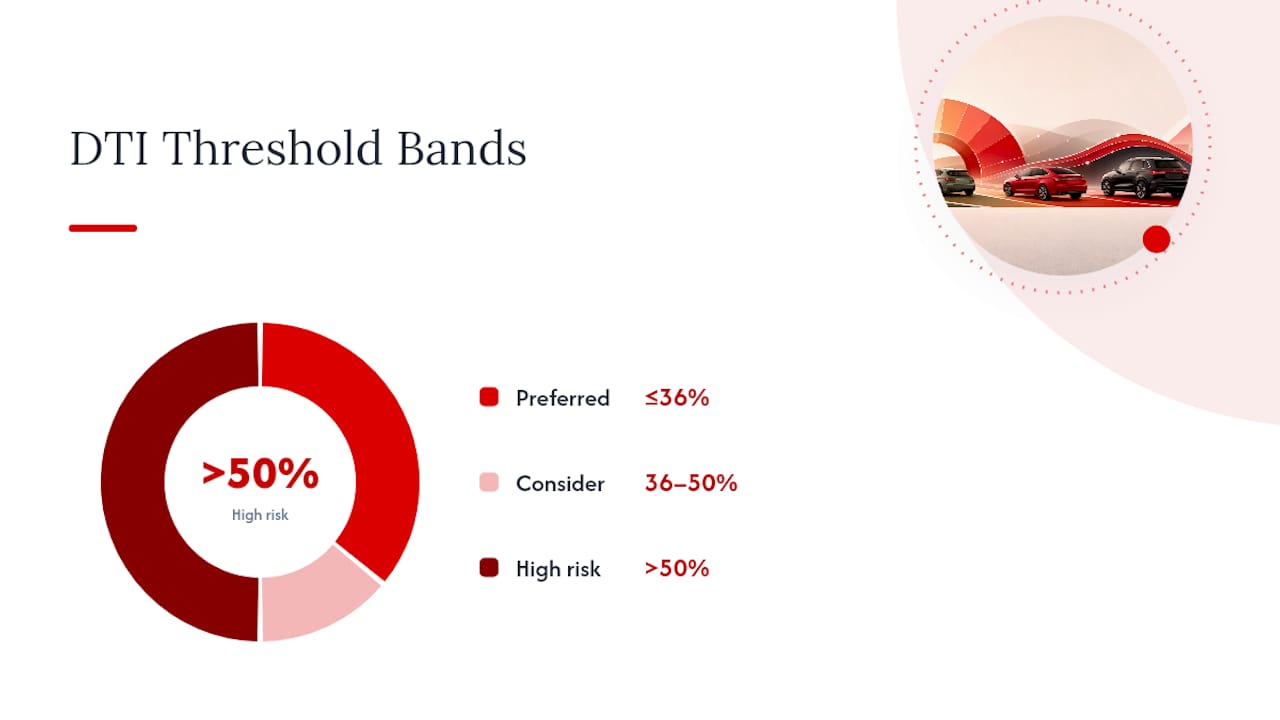
Statistic Callout: LendingTree reports that most lenders prefer a DTI below 36%, will consider 36% to 50% depending on credit score and down payment, and view anything above 50% as high risk.
If your income is irregular, whether you freelance, drive for a rideshare service, or work seasonal jobs, SoFi recommends gathering 3 to 6 months of bank deposits, 1099 forms, or W-2s so lenders can average your earnings instead of guessing. A partner guide on proof of income lenders actually accept breaks down exactly what documentation satisfies this requirement.
Common DTI Thresholds for Car Loans and Refinances
Lenders don't apply one universal cutoff, but there's enough consistency across the industry to give you real benchmarks. A DTI under 36% is generally treated as excellent and puts you in position for the best rates and loan terms.
Once your DTI climbs past 50%, Gerald's lending guide classifies that as high risk, meaning approval becomes far less likely through conventional lenders and more expensive when it happens through subprime channels.
Lender type changes the math, too:
- Traditional banks tend to hold the tightest DTI requirements and want to see 43% or lower.
- Credit unions are often more flexible, sometimes stretching to 50% for members with solid payment history elsewhere.
- Subprime and buy-here-pay-here lenders may approve DTI ratios above 50%, but with meaningfully higher interest rates to offset the added risk.
Refinancing follows slightly different norms. RateGenius notes that refinance lenders often cap DTI around 50%, and improving your ratio between your original purchase and your refinance application can genuinely lower your rate. If your income has increased or you've paid off a card since you bought the car, refinancing is worth revisiting.
How DTI Changes Your Approval Odds and Interest Rate
Underwriters rarely look at DTI in isolation. They weigh it alongside your credit score and the loan-to-value ratio on the vehicle itself, meaning how much you're financing relative to what the car is actually worth. A borrower with the same DTI and 580 score faces a very different conversation.
The practical impact of a higher DTI shows up in three places:
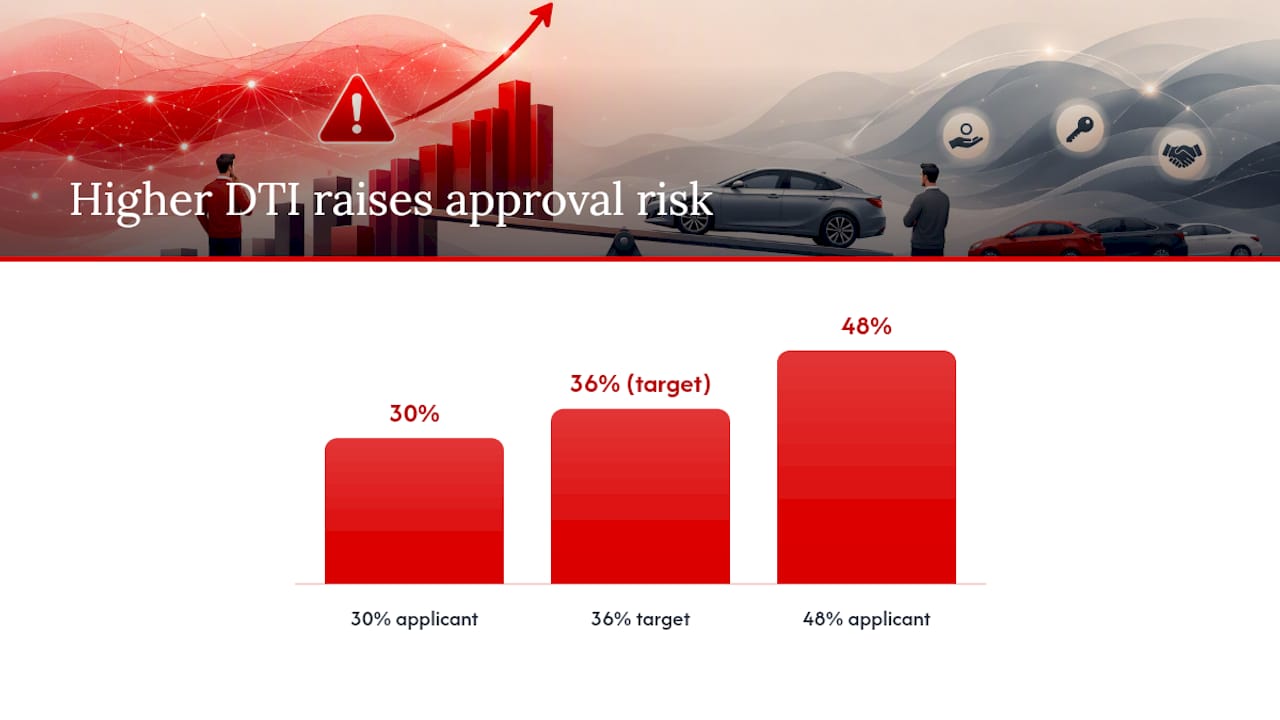
- Higher APR. Lenders price risk into your rate, so a 48% DTI applicant typically pays more interest than a 30% DTI applicant with similar credit.
- Smaller approved loan amount. Even if you're approved, the lender may cap how much they'll finance to keep your payment manageable relative to income.
- Fewer lender options. Some banks simply decline applications above their internal DTI ceiling, narrowing your choices to credit unions or subprime lenders.
Compensating factors can offset a DTI that's higher than ideal. A larger down payment reduces the loan amount and monthly payment, which directly lowers the DTI calculation lenders use for approval. A cosigner with strong credit and low debt adds income and reliability to the application without requiring you to pay off existing balances first.
Pro Tip: If your DTI sits right at a lender's cutoff, ask about adjusting the loan term. Stretching from 60 to 72 months lowers the monthly payment and your resulting DTI, though you'll pay more interest over the life of the loan. It's a trade worth understanding before you sign.
Practical Ways to Lower Your DTI Before You Apply
Improving DTI requirements for financing usually comes down to attacking one of two numbers: what you owe each month, or what you earn. Here's a ranked approach that starts with what you can do this week and moves toward longer-term strategy.
- Pay off or pay down small debts first. Knocking out a $75 monthly minimum on a credit card has an immediate, calculable effect on your DTI. Gerald's research points to this as one of the fastest levers available before an application.
- Stop opening new credit lines. Every new account adds a minimum payment to your debt total, even before you use it.
- Increase your down payment. A larger down payment shrinks the loan amount, which lowers the monthly payment used in your new DTI calculation. Even an extra $1,000 down can move the needle.
- Choose a debt payoff strategy that fits your situation. The debt snowball method (smallest balance first) builds momentum quickly. The debt avalanche method (highest interest rate first) saves more money long term. Either works for DTI purposes since both eventually eliminate a monthly payment.
- Consider consolidating high-interest debt. Combining several credit card balances into one lower-rate personal loan can reduce your total monthly obligation, even if the total balance stays similar.
- Shop credit unions before assuming denial. Because credit unions often carry more flexible thresholds, an application that gets declined at a national bank may still get approved locally.
- Add a cosigner if your income alone doesn't clear the bar. This works especially well for buyers early in their credit history or coming off a period of reduced income.
Pro Tip: Before you apply anywhere, pull your own credit report and calculate your DTI using the same debts a lender would count. Catching an old, forgotten account on your report before a lender does gives you time to fix it, or at least explain it, instead of getting blindsided at the finance desk.
If your DTI and credit history are both a challenge right now, it's worth reading through low income car financing options or bad credit car buying options before you walk into any dealership, so you know which structures actually fit your situation.
Payment-to-Income: The Metric That Runs Alongside DTI
Payment-to-income ratio, or PTI, isolates just the proposed car payment against your gross monthly income, rather than lumping it in with every other debt you carry. The formula is simple: divide your monthly car payment by your gross monthly income and multiply by 100.
SoFi's lending guidance points to PTI targets commonly falling in the 10% to 20% range, depending on the lender's internal policy.
Here's why this matters with a real comparison. Both DTIs look identical on paper, but Applicant B is asking the vehicle itself to absorb a much larger share of take-home pay. Lenders often approve Applicant A with standard terms and either decline Applicant B or require a larger down payment to bring that PTI down.
Key things to know about PTI:
- It's calculated using only the proposed vehicle payment, not your full debt picture.
- Most lenders view PTI as a supplement to DTI, not a replacement for it.
- A high PTI with a low DTI can still trigger a decline, so don't assume overall DTI tells the whole story.
How Elmwood Auto Sales Helps Buyers With a Higher DTI
A DTI on the higher end doesn't automatically shut the door on getting into a reliable vehicle. At Elmwood Auto Sales, our low-pressure approach means no commission-driven sales tactics pushing you toward financing you can't sustain. Every vehicle on our lot goes through a thorough inspection before it's offered for sale, so the car itself isn't adding financial risk on top of a tight budget.
We work with buyers across a range of credit histories, including tailored financing options and buy-here-pay-here solutions for those who don't fit a traditional bank's criteria. Our team can walk you through what documentation you'll need, help structure a down payment that actually improves your approval odds, and talk through loan terms honestly, including the trade-offs. For more detail on how different financing structures work, our guide to types of car financing options is a solid starting point.
Why DTI Deserves Attention, But Not Panic
The conventional advice on DTI treats it like a pass or fail test, and that framing does readers a disservice. DTI is one input among several, and the research bears this out: credit score, down payment, and income documentation can all shift a lender's decision even when your ratio sits above the textbook ideal.
What gets underrated is payment-to-income. Buyers obsess over their overall DTI while ignoring that the specific car payment they're choosing can sink an otherwise reasonable application. Shopping for a lower payment, whether through a bigger down payment or a different vehicle price point, often does more for approval odds than another month of debt payoff.
If there's one priority worth acting on first, it's this: calculate your DTI with the proposed payment included before you fall in love with a specific car. That single step prevents the most common financing disappointment, discovering at the finance desk that the number you liked doesn't match the number a lender will approve.
— Elmwood
Ready to See What You Qualify For?
Some dealerships give you a way to find out where you actually stand instead of guessing at your DTI from home and hoping for the best. Offering various financing options, they can sometimes work with buyers whose ratio sits outside what a typical bank accepts elsewhere.
Booking a test drive can be a chance to start the pre-approval conversation. Bring recent pay stubs, a valid ID, and proof of address, and the sales team may help you understand your numbers and how a down payment or trade-in might improve your terms. If buy-here-pay-here financing comes up as an option for your situation, the terms should be explained clearly so you know what you're agreeing to before signing anything. Schedule your test drive and find out what you actually qualify for.
Sources
- Debt-to-Income Ratio for Car Loans: What You Need to Know | LendingTree
- What's a Good Debt to Income Ratio (DTI) for a Car Loan? | TDECU