
Yes, Rhode Island has a lemon law, and it covers new and leased vehicles under 10,000 pounds. If your car has a substantial defect that shows up within the statutory term of protection, and it survives the required number of repair attempts or days out of service, the law presumes it's a lemon. Your remedy is a refund or a comparable replacement, minus a reasonable allowance for the miles you drove it.
TL;DR:
- A repair attempt of four or more times for the same defect or 30 total days out of service within 15,000 miles or one year triggers the law’s presumption of a lemon.
- The defect must substantially impair safety, use, or value, and damage claims are limited to new and leased vehicles under 10,000 pounds registered in Rhode Island.
- Refunds may deduct a reasonable value for miles driven before the defect was identified, especially if there was a trade-in involved.
- Owners should document repairs, days out of service, and correspondence thoroughly to support claims made to the arbitration board or courts.
- Used vehicles are covered by a different, faster threshold, often requiring fewer repairs or days out of service, and disputes generally are handled outside the state arbitration process.
Table of Contents
- Rhode Island Lemon Law Coverage: Vehicles, Timing, and Eligibility
- Repair Attempts and Days Out of Service: When the Law Presumes a Lemon
- What You Can Actually Get: Refunds, Replacements, and Use Deductions
- Filing a Claim: Arbitration, Manufacturer Programs, and BBB AUTO LINE
- Used Cars Work Differently: Dealer Warranty Rules Under RI Law
- Building Your Evidence File: What to Document and Why
- After You File: Realistic Outcomes and Enforcement
- An Elmwood Auto Sales Perspective on Avoiding Post-Sale Disputes
- Sources
Rhode Island Lemon Law Coverage: Vehicles, Timing, and Eligibility
The statute defines a covered "motor vehicle" as an automobile, truck, motorcycle, or van weighing under 10,000 pounds and sold or leased in Rhode Island. Leased vehicles get the same protections as purchased ones, so a lease doesn't put you outside the law's reach.
The clock starts at delivery, meaning the day you actually took possession, not the day you signed paperwork. From that date, you have a limited period of time or mileage limit, whichever comes first, to discover a defect and get it into the protection window. This is a shorter runway than many buyers expect, especially if a vehicle sits at a dealership for warranty repairs during that period.
A few scope details matter before you assume the law applies:
- Coverage applies to new vehicle sales and leases registered in Rhode Island, not vehicles purchased out of state and later brought in.
- The defect has to substantially impair the vehicle's use, market value, or safety. Minor cosmetic issues typically don't qualify.
- Used vehicles fall under a separate statute (more on that below), so don't assume the new-car rules apply to a three-year-old trade-in.
The Rhode Island Attorney General's Office publishes the clearest official summary of these thresholds, and it's worth bookmarking if you're tracking a live claim.
Repair Attempts and Days Out of Service: When the Law Presumes a Lemon
Rhode Island doesn't make you prove a manufacturer acted in bad faith. Instead, the law builds in a presumption once your repair history hits certain numbers.
- Four repair attempts. If a dealer or manufacturer has tried and failed to fix the same substantial defect four separate times within the one year or 15,000 mile window, the law presumes the vehicle is a lemon.
- Thirty cumulative days out of service. If the vehicle has been in the shop for repairs, for any combination of issues, for 30 total calendar days during that same period, the presumption also kicks in.
- Used-vehicle comparison. If you bought used and the issue falls under a dealer's written warranty instead, the threshold drops to fewer repair attempts or fewer days out of service under Chapter 31-5.4, a faster trigger.
Here's where owners trip up: the four attempts need to target the same nonconformity, not four unrelated problems. If your transmission gets fixed twice and your air conditioning gets fixed twice, that's not four attempts at one defect. It's two separate repair histories, and neither alone may meet the threshold.
A quick example. Say your engine stalls intermittently. The dealer attempts a fix in January, again in March, again in May, and a fourth time in July, each time for the same stalling complaint. That's your fourth attempt, and the presumption applies even if the car runs fine the day you pick it up. Days out of service count differently: if that same car sat at the dealership for 10 days in January, 8 days in March, 7 in May, and 6 in July, you're at 31 cumulative days, which independently triggers the presumption even without hitting four attempts.
What You Can Actually Get: Refunds, Replacements, and Use Deductions
Once the presumption applies, you choose the remedy, not the manufacturer. You can request a comparable replacement vehicle or a full refund of the purchase price, and the manufacturer doesn't get to decide which one they'd prefer to offer.
Refunds typically include a deduction known as a "reasonable allowance for use," which considers mileage before the defect became a qualifying lemon issue. Think of it as rent for the miles driven, not a penalty.
A few mechanics worth understanding before you negotiate:
- If you traded in a vehicle as part of the purchase, that trade-in value may be factored back into your refund.
- When a dealer or manufacturer disputes the value of a returned vehicle, wholesale valuation guides like NADA often serve as the reference point for that calculation, particularly on used-vehicle warranty claims.
- If you still owe money on the vehicle, your lienholder gets paid off first from any refund, with the remainder going to you.
- Incidental costs, like towing or a rental car during repairs, and in some cases attorney's fees, may be recoverable if you pursue arbitration or litigation successfully.
Refund math, simplified: If you paid a purchase price for a vehicle and drove a substantial portion of your mileage allowance before the defect became a qualifying lemon, expect a use deduction calculated against that mileage, not the full purchase price forgiven outright. The FindLaw summary of Rhode Island's statute confirms this "refund or replacement minus reasonable use" framework as the law's baseline remedy structure.
Filing a Claim: Arbitration, Manufacturer Programs, and BBB AUTO LINE
The path to a remedy usually runs through three stages, and skipping ahead rarely helps your case.
- Keep repairing through the dealer first. You need that documented repair history to establish the four-attempt or 30-day threshold. Walking away early weakens your claim.
- Try the manufacturer's informal dispute program, if one exists. Many manufacturers run their own arbitration or mediation process before state-level arbitration becomes available. Check your warranty booklet for this.
- File with the Rhode Island Motor Vehicle Arbitration Board. This is the state's dedicated forum for new-vehicle lemon law disputes, and it's where most Rhode Island claims end up if the manufacturer doesn't resolve things informally.
The Board reviews your repair records, hears from both sides, and issues a binding decision. One detail catches people off guard: the Motor Vehicle Arbitration Board does not provide you with legal representation. You present your own case, backed by your documentation, unless you bring an attorney at your own expense.
BBB AUTO LINE is a separate, nationally recognized alternative that some manufacturers use in place of or alongside state arbitration. If your manufacturer participates in BBB AUTO LINE, it can sometimes move faster than waiting for a state Board date, though outcomes depend heavily on your evidence either way.
Pro Tip: Call the Attorney General's consumer protection line before you file anything. They won't represent you, but they can confirm which forum applies to your specific manufacturer and catch scheduling mistakes before they cost you time.
Timelines vary, but most Rhode Island arbitration cases resolve within a few months of filing, assuming your documentation is complete when you submit it.
Used Cars Work Differently: Dealer Warranty Rules Under RI Law
If your problem vehicle was used when you bought it, the new-vehicle lemon law likely doesn't apply. Used-vehicle protections live in a separate statute, and the thresholds and remedies look different.
Rhode Island dealers selling used vehicles must provide a minimum written warranty, with terms scaled to mileage at time of sale under §31-5.4-2:
- Lower-mileage vehicles often carry warranties of a limited duration or mileage.
- Higher-mileage vehicles typically have shorter warranty terms, often measured in days or miles.
Under this framework, the presumption of a defect requiring remedy arrives faster, generally three repair attempts or 15 days out of service rather than the new-car thresholds. When a dealer refuses to honor that written warranty, §31-5.4-3 authorizes refund or return remedies, with wholesale valuation guides used to calculate trade-in adjustments. Used-vehicle disputes generally don't route through the Motor Vehicle Arbitration Board. If a dealer stonewalls you, consulting an attorney is often the more effective next step than pursuing state arbitration.
Building Your Evidence File: What to Document and Why
Arbitration boards and attorneys both work from paper, not memory. Start your file the day you notice the first defect.
- Save every repair order and invoice, dated and itemized, showing the specific complaint, the work performed, and the outcome. Vague descriptions like "checked and adjusted" hurt your case; specific ones like "replaced fuel injector #3, stalling persisted" help it.
- Track days out of service in a simple log. Note the drop-off date, pickup date, mileage at each point, and what was diagnosed. A basic spreadsheet works fine.
- Photograph anything visual, warning lights, fluid leaks, dashboard error codes, with timestamps if your phone supports it.
- Keep loaner and rental agreements, since these help establish both days out of service and any incidental costs you might recover.
- Save every written response from the dealer or manufacturer, including emails, denial letters, and dispute program correspondence. If they promised something verbally, follow up in writing and ask them to confirm.
Getting documents out of a dealership can be slower than it should be. Ask for copies at the time of service, not weeks later, and follow up by email so there's a timestamp on your request.
Pro Tip: Request a copy of every repair order before you leave the service counter, even if the advisor says they'll email it later. Paperwork that "will be sent" has a way of never arriving once a claim gets contentious.
After You File: Realistic Outcomes and Enforcement
Arbitration doesn't guarantee a win. The Board can order a full refund, a comparable replacement, partial relief, or deny the claim entirely if your documentation doesn't meet the threshold.
- If you win a refund, expect your lienholder to be paid first from the proceeds, with any remainder coming to you.
- Attorney's fees become recoverable in some successful cases, particularly when a dispute escalates beyond arbitration into court.
- A denied arbitration claim doesn't necessarily end your options. You may still pursue the matter in court if you believe the Board got it wrong or new evidence surfaces.
- Before accepting any settlement offer, weigh it against your actual refund calculation. Manufacturers sometimes offer less than the reasonable-allowance-for-use math supports, hoping you'll accept rather than continue the process.
An Elmwood Auto Sales Perspective on Avoiding Post-Sale Disputes
Most lemon law disputes we hear about start the same way: a buyer wasn't given clear documentation at the point of sale, and by the time a problem shows up, nobody can agree on what was disclosed or promised.
That's why it is important to run a full inspection on every vehicle before it reaches the lot, and give buyers a written report they can actually keep, not a verbal reassurance that evaporates the moment they drive off. Warranty terms should be put in writing at signing, so there's no ambiguity later about what's covered and for how long.
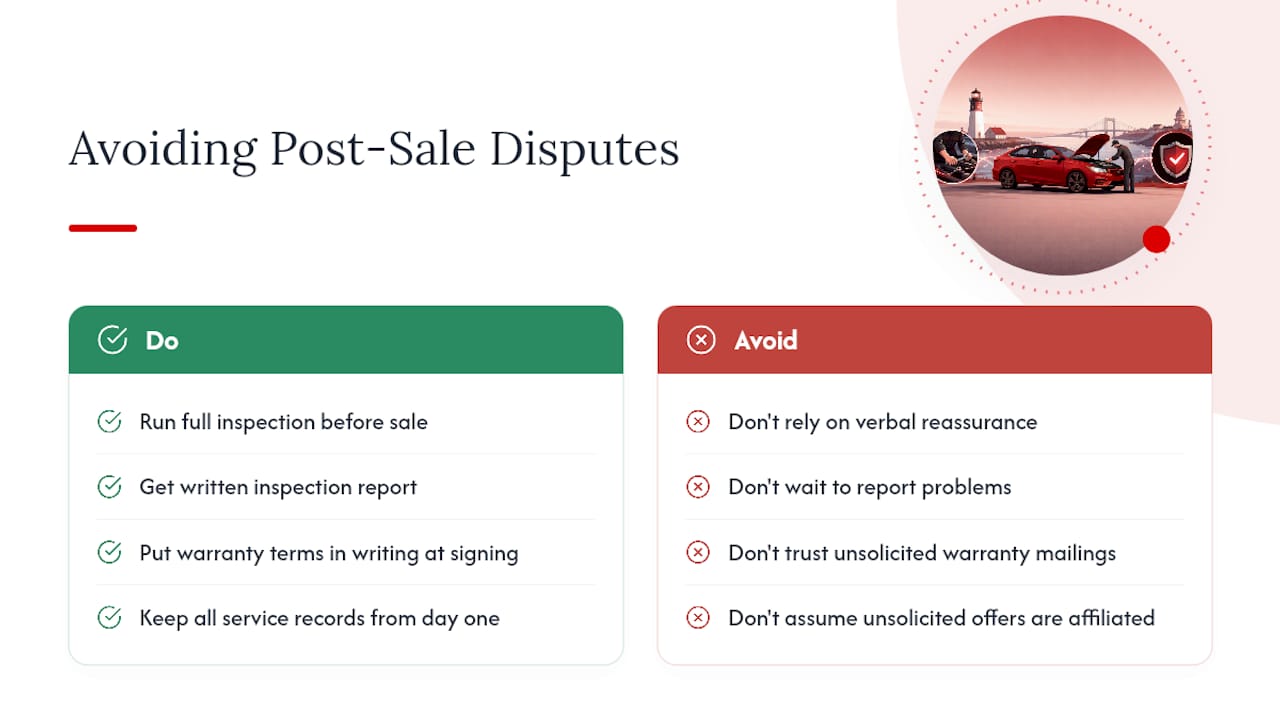
If you're buying anywhere, not just from us, ask for the inspection report and the written warranty before you sign. Keep every service record from day one, and if something feels off, contact the dealer immediately rather than waiting. Prompt communication is often what separates a quick repair from a drawn-out dispute. If unsolicited extended warranty offers show up in your mailbox after purchase, treat them with skepticism, since many are unaffiliated with your actual dealer or manufacturer.
Looking for a vehicle that comes with that kind of documentation from day one? You can schedule a test drive with our Providence team and see the inspection report before you commit to anything.
— Elmwood
This article is general information, not a substitute for advice from a qualified lawyer. Consult a qualified legal professional about your own circumstances before acting on anything here.
Sources
- Lemon Law | Rhode Island Attorney General's Office
- Rhode Island General Laws Title 31. Motor and Other Vehicles §31-5.4-2. Written warranty required--Terms
- General Laws of Rhode Island Section 31-5.4-3. (2025) - Failure to honor warranty.
- Rhode Island Lemon Laws - FindLaw