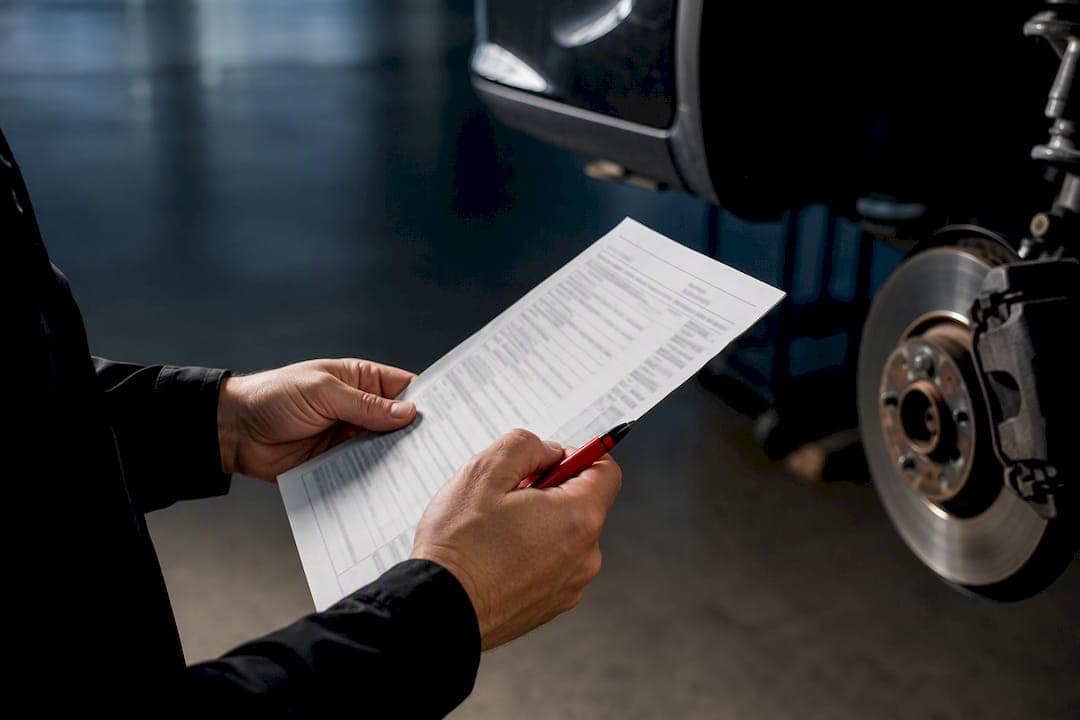
A dealer pre-sale inspection is a multi-point check of the engine, brakes, suspension, tires, electrical systems, and fluids, backed by an OBD-II diagnostic scan and a written checklist with a vehicle history report attached. That covers safety and drivability. It does not always match the objectivity of an independent inspection, so high-mileage, out-of-state, or unclear-history vehicles are worth a second look before you sign anything.
TL;DR:
- Dealer inspections primarily check safety and drivability but may miss issues like sensor faults or long-term transmission health.
- A thorough inspection should include signed check sheets, OBD-II reports, timestamped photos, and vehicle history reports to verify condition.
- Independent pre-purchase inspections offer deeper analysis such as lift and undercarriage checks, which can reveal problems hidden during dealer evaluations.
- Variations in dealer inspection quality mean asking for actual checklists and signed reports provides better assurance of vehicle condition before buying.
- Rhode Island law requires honest paperwork but does not mandate detailed mechanical checks, making dealer reputation and inspection thoroughness crucial.
Table of Contents
- What a Dealer Multi-Point Inspection Checklist Covers
- How Dealers Document What They Find
- What Dealer Inspections Might Miss
- Dealer Inspection vs. Independent Pre-Purchase Inspection
- Turning Inspection Findings into a Better Deal
- Rhode Island Rules Dealers Follow for Pre-Sale Inspections
- Safety Checks Buyers Should Expect on a Used Car in RI
- Why a Thorough Dealer Checklist Matters More Than a Bare Minimum
- Elmwood's Take: What We Inspect and Why We Show You
- See the Inspection Paperwork Before You Buy
- Where to Verify Inspection Standards Yourself
- Sources
What a Dealer Multi-Point Inspection Checklist Covers
A multi-point inspection is a system-by-system review of a vehicle's major components, and it's the backbone of any dealer's pre-sale process. When you're looking at a used car in Providence, ask to see the actual checklist rather than taking a verbal "it's been inspected" at face value. Here's what a thorough one covers:
- Engine and drivetrain: technicians check for fluid leaks, belt wear, fluid color and levels, and how the transmission shifts under load.
- Brakes: pad thickness, rotor condition, caliper function, and the condition of the brake fluid itself.
- Suspension and steering: shocks and struts for bounce or leaks, ball joints and tie rods checked for excess play.
- Tires and wheels: tread depth across the tire face, uneven wear patterns that hint at alignment issues, sidewall cracking, and a check of the tire pressure monitoring system.
- Electrical and diagnostics: battery health, charging system output, exterior and interior lights, and a full OBD-II scan for stored or pending trouble codes.
- Body and structural condition: paint-thickness readings across panels to catch prior bodywork, panel gap consistency, and a look underneath for rust or frame damage.
- Interior and safety systems: airbag warning lights, seatbelt function, HVAC performance, and general seat and trim condition.
- Administrative checks: a VIN verification, an open-recall check, and a Vehicle History Report attached to the file.
Any one of these items skipped is a gap. A rattling suspension or a slow-leaking brake line rarely shows up on a five-minute test drive around the block, which is exactly why the checklist matters more than the drive itself.
How Dealers Document What They Find
A verbal assurance means nothing without paper behind it. A proper inspection produces a paper and digital trail you should ask to see before you buy, not after.
- A signed inspection check sheet. The technician who performed the work and the service manager who reviewed it both sign off, and you as the buyer should be able to see that signature, not just a printed name.
- An OBD-II diagnostic report that distinguishes stored codes (active problems) from pending codes (issues still being confirmed by the vehicle's computer), along with a plain-language note on what each one means.
- Photos and test-drive notes, ideally timestamped, showing the condition of the car at the time of inspection and documenting how it behaved on the road and on a lift.
- A Vehicle History Report, whether Carfax or AutoCheck, attached directly to the inspection file with the VIN cross-checked against the title and dashboard.
An example 160-point dealer inspection check sheet shows exactly this structure: completed line items, dual sign-off, and an attached history report kept in the vehicle's permanent file.
What Dealer Inspections Might Miss
Even a well-run inspection has limits. A checklist tells you the car's current condition; it doesn't promise how the transmission will hold up in three years. Modern vehicles can also develop what mechanics sometimes call "ghost faults," sensor or module errors that don't trigger a dashboard light right away and need a deeper, module-specific scan to catch.
Watch for these red flags on any inspection report:
- Uneven panel gaps or paint-thickness readings that jump between adjacent panels.
- Active or recently cleared OBD-II codes with no explanation attached.
- Service records that don't line up with the mileage on the odometer.
- Fluid that looks contaminated, milky, or the wrong color for its type.
- A report that's unsigned, undated, or vague on specifics.
Pro Tip: If a dealer hands you a one-page checklist with boxes checked but no technician signature or photos, that's not a red flag, that's a blank spot. Ask for the full report before you negotiate.
Dealer Inspection vs. Independent Pre-Purchase Inspection
A dealer inspection and an independent pre-purchase inspection (PPI) aren't competing products. They answer different questions. A dealer's technician works from the same checklist every time; an independent mechanic has no stake in whether you buy the car, which is exactly why Consumer Reports points to that objectivity as the real value of a second opinion, especially on higher-mileage or out-of-state vehicles.
A typical independent PPI includes:
- A full lift inspection of the undercarriage.
- A deeper OBD-II scan than a quick code pull, checking module-specific data.
- Paint-thickness readings across every panel.
- A road test focused specifically on drivability, not just a spin around the lot.
- A written report, often with photos attached.
Expect to pay $100 to $300 for an independent or mobile inspection, with most evaluations wrapping up in an hour or two. If your budget or timeline is tight, prioritize the lift inspection and the deep OBD-II scan. Those two steps catch the issues a test drive can't.
Turning Inspection Findings into a Better Deal
An inspection report isn't just paperwork. It's leverage, if you know how to use it. Here's how to translate findings into an actual conversation with a salesperson:
- List every item by category. Separate safety issues (worn brake pads, a leaking suspension component) from cosmetic ones (a scuffed bumper, faded trim).
- Prioritize the safety items first. A dealer is far more likely to negotiate on a brake job than a cosmetic scratch, and you should push harder there.
- Ask for a specific remedy. Request either an itemized repair before delivery, a price reduction equal to the repair cost, or added warranty coverage on the affected system.
- Confirm the timeline. Most dealer inspections turn around in the same day to 48 hours. If you're paying for an independent PPI yourself, factor that time in before you commit to a purchase date.
A sample script that works: "Your inspection notes the rear brake pads at 20 percent. Can you either replace them before delivery or knock $300 off the price?" Specific, documented, and hard to argue with.
Pro Tip: Bring a printed copy of the inspection report to the negotiation table. Salespeople respond differently to a document with their own dealership's letterhead than to a verbal complaint.
Rhode Island Rules Dealers Follow for Pre-Sale Inspections
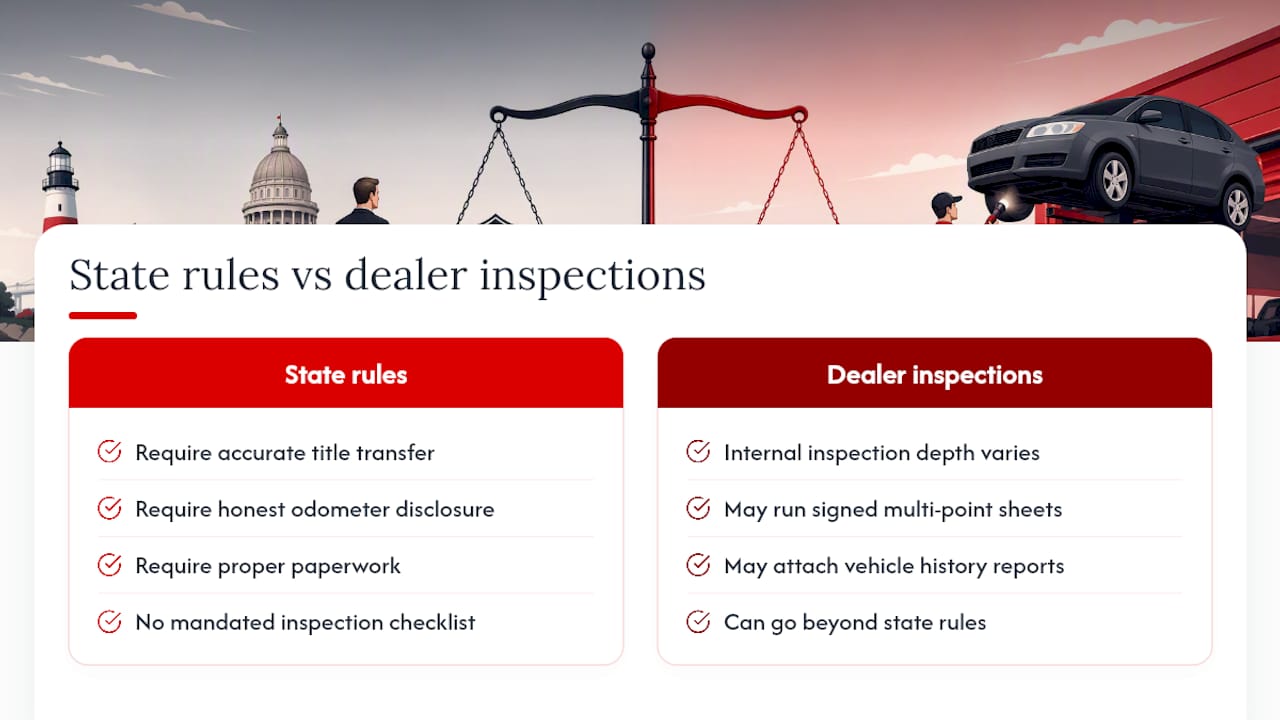
Rhode Island's licensed dealers operate under state motor vehicle dealer regulations that require accurate title transfer, honest odometer disclosure, and proper documentation on every vehicle sold. Those rules set the baseline for paperwork integrity, but they don't specify a single mandated inspection checklist that every dealer must follow item by item.
That gap is exactly why the quality of a dealer's own inspection program matters so much in Providence and the surrounding area. Two dealers can both be fully licensed under Rhode Island law and still offer wildly different levels of pre-sale scrutiny, because the state's compliance requirements focus on transactional honesty (correct mileage, clean title transfer, accurate paperwork) rather than dictating exactly how deep a mechanical inspection has to go.
For buyers, that means the dealer's own reputation and internal process carry real weight. A dealership that voluntarily runs a documented multi-point inspection, with signed check sheets and attached history reports, is going well beyond what state licensing alone requires. If a lot's paperwork looks thin on the mechanical side, that's worth asking about directly. Rhode Island's licensing framework protects you against title fraud and rolled-back odometers. It doesn't guarantee the transmission was checked.
Safety Checks Buyers Should Expect on a Used Car in RI
Rhode Island's approach to used vehicle inspections centers on ensuring a car is safe to register and drive once it changes hands, and dealers who take pre-sale inspection seriously build their checklists around those same safety fundamentals: brakes, tires, lights, and steering components that directly affect how the car handles on the road.
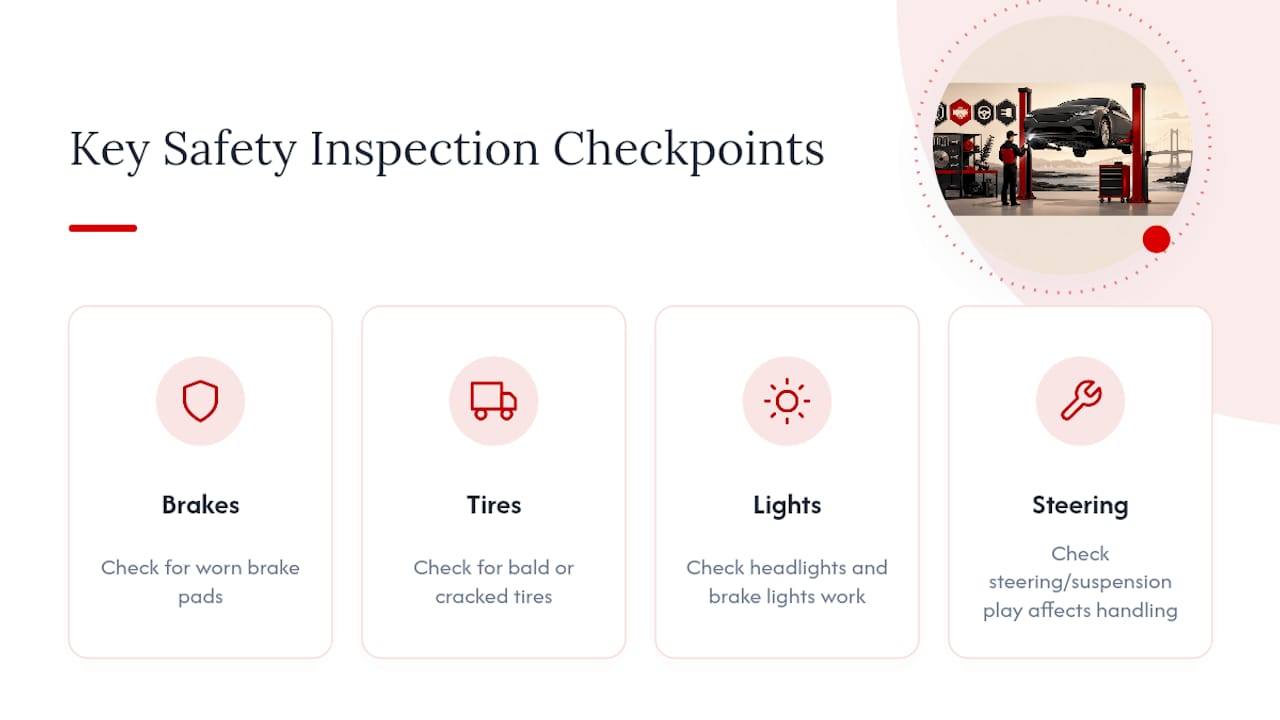
A dealer's internal safety review typically mirrors what a state-level check would flag: worn brake pads, bald or cracked tires, non-functioning headlights or brake lights, and steering or suspension play that affects handling. The difference is timing. A dealer inspection happens before you buy, giving you the chance to negotiate repairs or a price adjustment. A state-level check happens after the sale, when the car is already yours.
That's the practical reason a strong pre-sale inspection matters more to you as a buyer than it might seem. If a dealer's checklist catches a brake issue now, you're negotiating from a position of leverage. If it surfaces later, you're paying for it out of pocket with no seller involved. Ask specifically whether the dealer's checklist includes the same safety items, brakes, tires, lights, steering, that would matter for the vehicle's continued road use, and get that confirmation in writing before you commit.
Why a Thorough Dealer Checklist Matters More Than a Bare Minimum
There's no single federal inspection standard that governs used car sales the way there is for, say, seatbelt manufacturing or airbag design. Federal rules set safety equipment standards for how a vehicle is built. They don't require a specific pre-sale inspection process for used cars sold at the retail level. That responsibility falls to individual dealers and, to a lesser degree, to state-level licensing rules.
Practically, this means the depth of your inspection depends entirely on which dealer you're standing in front of, not on some universal checklist every used car lot in the country follows. Some dealerships run a bare-bones visual check. Others run a full multi-point process with signed sheets, OBD-II scans, and attached history reports, closer to what a 300-point pre-delivery inspection covers at the higher end of the industry.
That variation is exactly why asking to see the actual checklist, not just hearing that "it passed inspection," matters so much when you're shopping in Providence. A dealer with nothing to hide will hand over the paperwork without hesitation. One who hedges or offers a vague verbal assurance instead of a signed document is telling you something, whether they mean to or not. If you want a deeper look at how local dealer practices intersect with Rhode Island inspection rules, it's worth reading before you shop.
Elmwood's Take: What We Inspect and Why We Show You
This dealership was built around the idea of no commission-based pressure, and no shortcuts on inspections. Every car offered for sale gets a full mechanical review, and buyers can see the actual signed check sheet, not a summary. The vehicle history report and test-drive notes are attached, and the OBD-II results are explained to the buyer. If something on the report needs discussion, the conversation happens before any signing.
— Elmwood
See the Inspection Paperwork Before You Buy
You shouldn't have to take anyone's word for how thoroughly a used car was checked before it hit the lot. At Elmwood Auto Sales, you can ask to see the signed inspection check sheet and OBD-II diagnostic results on any vehicle before you ever get behind the wheel.
Every car in our Providence inventory goes through that same documented process, and our team will walk through the findings with you in person, no rushed sales pitch involved. We also offer in-house and third-party financing options for a range of credit histories, so the inspection isn't the only thing you can ask about while you're here. If you're ready to see a car in person, schedule a test drive and bring your questions about the inspection report with you.
Where to Verify Inspection Standards Yourself
A few outside resources are worth bookmarking if you want to double-check inspection practices on your own:
- Consumer Reports' guide to inspecting a used car, including PPI advice and cold-start checks.
- Erie Insurance's explainer on what a multi-point inspection covers and when to schedule one.
- A sample 160-point dealer check sheet that shows what thorough documentation looks like.
Sources
- What Is a Multi-Point Inspection (And When Does My Car Need One)? | Erie Insurance
- How to Inspect a Used Car to Avoid Costly Repairs - Consumer Reports
- 160-Point inspection check sheet example (dealer QA) | TCUV
- Pre-Purchase Car Inspections: What Are They and Who Needs One? – Sherpa Auto Transport